
In nonprofit financial management, disconnected systems often create operational inefficiencies and friction. When a grant, major donation, or supplier invoice originates in a CRM but settles in an isolated ledger, finance teams waste hundreds of hours on manual reconciliation.
The Charity Commission has reported that charities in Wales and England have collectively spent £100 billion in 2024, while income has reached £102 billion. Moreover, it was also found that 41% of charities had expenditure greater than income.
For finance leaders evaluating financial and accounting software for nonprofits, establishing a connected technology stack that automates fund accounting, enforces UK SORP compliance, and integrates with your core CRM should be the top priority.
Why Does Financial Software Matter for Nonprofits?
Non-profits simultaneously manage complex, distinct revenue streams, including restricted grants, public donations, trading income, and UK Gift Aid claims. Grants, donations, membership income, trading activity, and restricted funding can each have different reporting requirements.
Moreover, this creates a data problem when information related to finance is distributed across spreadsheets, CRM systems, fundraising tools, and banking platforms. Charity Digital’s 2026 fundraising research has found that charities use an average of four systems or even tools every week, but only 8% stated that their technology was very well integrated.
When systems do not exchange reliable data, finance teams spend valuable time manually exporting files and reconciling entries. Implementing an enterprise Salesforce ERP integration bridges the gap between fundraising activity and back-office accounting ledgers.
What Should Financial and Accounting Software Include?
A suitable platform should always support the financial processes of an organisation instead of forcing staff to create workarounds, and it should also make core controls easier to apply. Let’s dive in and understand it through pointers.
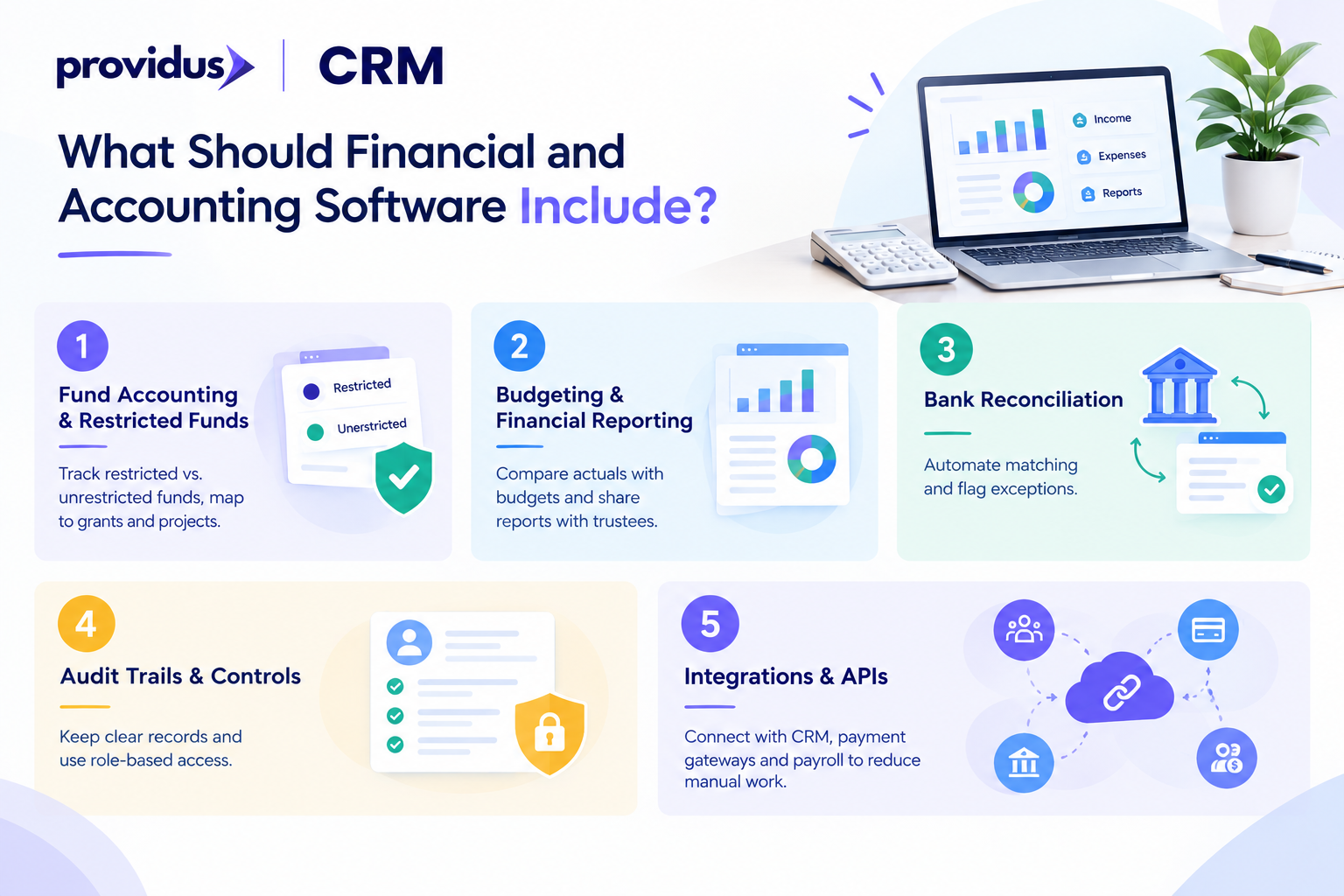
1. Fund Accounting and Restricted Funds
Non-profits must track restricted vs. unrestricted funds down to the general ledger level, ensuring transactions seamlessly map to specific grants, projects, and UK SORP reporting requirements.
2. Budgeting and Financial Reporting
Finance teams should also compare actual spending against analysis variances and budgets and produce reports for trustees and management.
3. Bank Reconciliation
Bank reconciliation should be automated rather than dependent on manual spreadsheets. Integrating tools like FinDock allows platforms to match incoming bank feeds against records automatically and flag exceptions for review.
4. Audit Trails and Controls
Financial systems should give clear records of who changed, created, or even approved important transactions. Role-based permissions and approval workflows can reduce the risk of unauthorized changes while creating a useful audit trail.
5. Integrations and APIs
A finance platform delivers significantly more value when connected to your CRM, payment gateways, and payroll systems via robust APIs or pre-built connectors. Connectors and APIs can reduce the manual workflow, but the design must explain how duplicates and errors are handled.
How Does Financial Software Connect with a Nonprofit CRM?
CRM and finance systems serve different purposes but mostly need to work together. A CRM serves as the system of engagement for campaign, donor, and grant management, while the financial software serves as the system of record for accounting controls.
For example, when a donation is processed through FundraiseUp, the gift record updates inside Salesforce while generating journal entries in your general ledger. Bi-directional sync ensures payment statuses remain reconciled across both platforms.
This is the point where financial software for nonprofits should be evaluated as a part of the wider technological architecture instead of an isolated accounting application. A technically strong implementation always reduces duplicate entry.
What Are the Main Benefits of Integrated Financial Management?
Connected information helps leaders understand how much money was spent or received and also where it came from and whether activity aligns with budget or not. Reconciliation and automated transfers can reduce the workflow of spreadsheets and allow finance professionals to focus on planning and analysis. This can become particularly important as transaction volumes and reporting requirements increase.
Moreover, finance teams also produce more consistent reports when the transaction data follows the defined structure, this is also essential when funders, trustees, or even internal teams need information related to restricted funding or programme expenditure.
How Should Nonprofits Choose the Right Software?
Start with the financial workflow rather than the feature list. Map how money enters the organisation, how expenditure is approved, how transactions reach the ledger, how funds are allocated, how reconciliation takes place, and how reports are generated.
Next, identify the organisation’s data model and determine where grants, donor information, funds, suppliers, programmes, budgets, and transactions should reside. Clear data ownership prevents two systems from becoming competing sources of truth. Salesforce nonprofit consulting can help organisations assess their data structure and align their financial processes with the right technology.
Finally, evaluate the integration requirements. Determine whether the platform offers suitable APIs or connectors, whether synchronisation happens in real time or on a scheduled basis, and how integration failures are detected and resolved. These considerations will help you assess your options and choose the right software for your organisation.
What are the Common Mistakes to Avoid?
Choosing software only because it is not expensive can create higher costs later. A system that requires constant exports, manual reconciliation, or even duplicated records may consume staff time that was not included in the original budget.
Another mistake is treating accounting software as a standalone solution. If fundraising, CRM, and finance platforms cannot exchange information reliably, staff may still need spreadsheets to bridge the gaps.
Migrating inaccurate or duplicated records into a new platform perpetuates legacy data issues. Non-profits should clean records and follow established Salesforce data migration best practices prior to cutover. Moreover, security should be the priority from the beginning.
Because financial systems store sensitive organizational and donor data, security controls and alignment with nonprofit cybersecurity strategies must be established during implementation.
When Should a Nonprofit Consider Integrated Financial Software?
The need becomes clearer when finance teams repeatedly perform manual tasks or cannot easily answer questions about income, expenditure and funding. Growth can also expose weaknesses that were manageable when transaction volumes were smaller.
A nonprofit may benefit from financial software for nonprofits when it manages multiple funding streams, programmes, entities, payment channels or reporting requirements. However, the correct solution depends on the organisation’s processes and technology landscape. Organisations should automate processes while keeping review around exceptions, approvals and financial decisions.
How Can ProvidusCRM Help?
Selecting the right platform is only the beginning; the real value of financial software for nonprofits comes from designing the integrations, data model, and workflow so that finance and operational systems work collectively without compromising financial control and accountability.
ProvidusCRM can help nonprofits assess their Salesforce architecture, migrate data, design workflows around operational requirements, and also integrate Salesforce with the relevant financial systems. This approach can create a well-connected environment in which finance data and CRM support better decision-making and visibility.
If your organization faces disconnected financial or CRM data, explore our Salesforce Consulting Services or contact ProvidusCRM to schedule a technical architecture discovery call
Conclusion
The best financial software for non-profits is not the one with the longest feature list, but the solution that best aligns with your reporting requirements, funding structure, and overall Salesforce architecture.
For small organisations, a focused accounting platform might be sufficient, but as the element of complexity increases, fundraising, integration with CRM and other operational systems become increasingly important.
The good decision begins by understanding how the financial data moves through the organisation, and for a growing organisation, financial software for nonprofit should support that workflow instead of creating another isolated system.
Frequently Asked Questions
1. Can nonprofit accounting software handle restricted funds?
Yes, suitable systems can track restricted funds separately and support reporting against their specific purposes.
2. Does a nonprofit need both a CRM and accounting software?
Usually, yes, because the two systems manage different types of information and controls.
3. Should nonprofit financial software be cloud-based?
Cloud deployment can improve accessibility and maintenance, but security, compliance, and integration requirements should be assessed first.
4. How often should nonprofit financial data be reconciled?
Reconciliation frequency should match transaction volume, risk, and reporting requirements, with higher-volume operations generally requiring more frequent checks.
5. Can accounting software manage grant reporting?
Some platforms can support grant-related tracking and reporting, but organisations should verify the specific grant-management requirements they need.