
 Manufacturing
Manufacturing Cloud
Loading…

Certified
Salesforce Partner
in the UK
At ProvidusCRM, we configure Salesforce Data Cloud so that customer records from your CRM, website, transactions, and other tools merge correctly into a single profile. Your segments, reports, and AI features run on data your team can actually trust.
Certified Data Cloud expertise
Identity resolution that merges records correctly
Data accurate enough for reports and AI features
Ongoing monitoring so accuracy does not drift











Data Cloud can unify all your customer signals and stream them in real time to Sales Cloud, Service Cloud, Marketing Cloud, and Agentforce.
But that promise only holds when identity resolution, ingestion, and governance are configured with care.
Three problems quietly break most implementations before they deliver value.
.webp&w=3840&q=75)
Your website, CRM, ecommerce, and support tools each hold a different version of the same customer. Segments target the wrong people, reports contradict each other, and AI features surface confident recommendations built on records that should never have existed as separate profiles.
.webp&w=3840&q=75)
The same customer sits in your systems three times, sometimes five. Each duplicate carries partial history and partial preferences. So your reports overcount, your marketing sends the same email twice with different subject lines, and your customer notices the amateur hour.
.webp&w=3840&q=75)
Einstein and Agentforce run on the data you give them. Feed them fragmented records, and they generate confident nonsense your team quickly learns to ignore. The result? Your AI investment stalls, not because the technology fails, but because the underlying data quietly undermines it.
ProvidusCRM houses a team of Salesforce architects, developers, and consultants with expertise across the platform’s ecosystem, including Data Cloud. We ensure your CRM works with a single source of truth, driving efficient workflows and reliable automation



Most Data Cloud problems start before configuration. Someone chose the wrong data sources to bring in first, skipped identity resolution planning, or bought Data Cloud without a clear activation goal. Our consulting engagement gets these decisions right at the start.
Our consultants map your source systems, review your existing data quality, and design the identity resolution and governance approach that fits your business. We plan the ingestion sequence carefully, so the identity backbone is built before behavioural data floods in. Therefore, you start the build with a foundation on which the rest of the project can actually rest.
Source system audit and data quality review
Identity resolution and match rule strategy
Ingestion sequencing plan built for accuracy
Governance framework aligned with your data owners
ManufacturingManufacturing Cloud
 Retail & eCommerce
Commerce Cloud



Our consultants set up Service Cloud so support agents resolve cases faster and managers see the full picture of service performance.

Our consultants build Experience Cloud portals for customers, partners, and employees that connect properly to your underlying Salesforce data.

Our consultants configure Sales Cloud around how your sales team works day to day. We map lead routing, opportunity stages, and forecasting views to your process, so reps sell more and managers coach better.

Most AI tools answer questions and stop there. Agentforce agents go further and actually do the work. Our consultants build agents that qualify leads, route cases, and complete routine tasks inside your workflows.

Our consultants implement Marketing Cloud so journeys, data extensions, and reporting all connect properly to your CRM data.

Our consultants configure Revenue Cloud and CPQ so quotes stay fast and accurate, even as your product catalogue and business grow more complex over time.
Identity resolution decides whether two records belong to the same person.
Get it right, and every dashboard, segment, and AI feature downstream becomes trustworthy. Get it wrong, and you cannot trust anything Data Cloud produces.
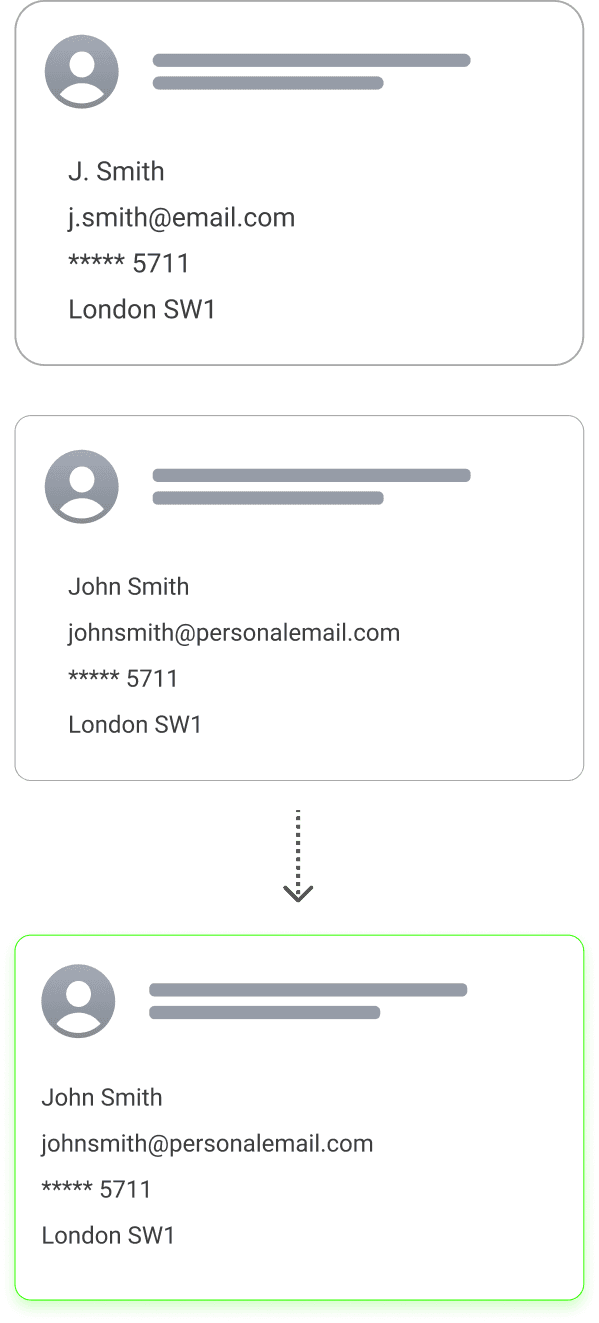
Exact-match-only rules miss obvious duplicates: "John Smith" and "J. Smith" pointing at the same phone number stay as separate profiles.
Loose, misdirected matching goes the other way, merging two different people who share a common name and a nearby postcode. The right configuration sits between these extremes.
Consider "J. Smith, jsmith@email.com, mobile ending 4471, London SW1" and "John Smith, john.smith@personalemail.com, mobile ending 4471, London SW1".
A default configuration keeps them as two profiles. A properly configured multi-attribute rule merges them into one unified profile with two known email addresses, tuned against real sample data.
Once records merge, Data Cloud picks which field values win. Consent should use "most restrictive wins" to avoid contacting opt-outs.
Loyalty status should use "highest value wins" to avoid downgrading customers. Our consultants make these decisions field by field, documented with your data owners.

Our consultants hold Salesforce Data Cloud certifications and have delivered projects across financial services, retail, and healthcare markets. Therefore, you get judgment from teams who have configured match rules and survivorship logic under production conditions rather than in training scenarios.

Match rule design and governance are their own discipline inside Data Cloud, not a subtask of a broader Salesforce implementation. Our consultants treat them accordingly, designing against sample data and documenting each decision with your data owners.
Data Cloud accuracy degrades quietly without oversight. Our team monitors match confidence, duplicate rates, and consent flow health week by week after go-live. Therefore, your Data Cloud investment keeps performing rather than needing rescue work later.

It keeps a live, unified view of each customer that Sales Cloud, Service Cloud, Marketing Cloud, and Agentforce can read from within seconds. Its strength is the speed of activation across your Salesforce ecosystem.
It holds large volumes of structured data across the whole business, so analysts can query it flexibly for reports, dashboards, and modelling. Its strength is analytical depth across every function, not just customer records.
Data Cloud handles operational customer activation. The warehouse handles cross-business analysis. Zero-copy sharing with Snowflake and Databricks lets both platforms reference data without duplicating storage.
Businesses purchase the Data Cloud license, expecting data warehouse-style reporting end up disappointed. Businesses that refuse Data Cloud because they already have a warehouse end up with Salesforce activation gaps. Our consultants map which layer holds which workload, based on how your business actually operates.

Donor, supporter, volunteer, and beneficiary data often live in separate systems. Our consultants configure Data Cloud alongside Nonprofit Cloud so fundraising, programme delivery, and stewardship teams share one accurate view of each supporter across the organisation.

Retail customers move across mobile, desktop, in-store, and support in a single week. Our consultants configure Data Cloud and align it with Commerce Cloud to resolve these signals against a unified profile in real time, so loyalty attributes and browsing behaviour sit under one identity.

Patient identity resolution carries higher stakes than any other sector. Our consultants configure Data Cloud alongside Health Cloud with match rules that respect patient identifiers and consent scopes, treating identity accuracy as a compliance obligation rather than a marketing optimisation.

Students, applicants, alumni, and donors sit inside education data. Our consultants implement Data Cloud alongside Education Cloud to connect that lifecycle, so recruitment and advancement teams work from the same view without gaps between departments.

Banks, lenders, and wealth firms need household matching under regulatory constraints. Our consultants configure Data Cloud match and household rules that reflect these relationships accurately, while keeping KYC and consent boundaries intact for compliance teams.

Manufacturers hold customer data across sales, distributors, service, and IoT signals from installed products. Our consultants implement Data Cloud alongside Manufacturing Cloud to unify these signals, so account teams work from a full picture rather than fragments.
No. Salesforce Data Cloud is the official, current name for the platform. In the past, Salesforce has referred to its underlying data unification vision as "Customer 360" or "Data 360," and the product was briefly codenamed "Genie." Today, the standalone, enterprise product is officially called Salesforce Data Cloud.
Often yes, since they do different jobs. Data Cloud is the operational activation layer inside Salesforce. Your warehouse is the analytical layer across the business. They connect through zero-copy sharing with Snowflake and Databricks.
Deduplication finds identical records in one system. Identity resolution links records across many systems using multi-attribute logic, and decides which field values survive the merge. It is a bigger, more deliberate decision than deduplication.
Yes. Data Cloud supports zero-copy sharing with Snowflake and Databricks, so data can be referenced across platforms without duplicating storage. BigQuery integration works through connectors. Our consultants design the sync pattern based on your setup.
Agentforce reads Data Cloud as its source of unified customer context. Agents use it through Retrieval-Augmented Generation to ground responses in current customer data rather than static knowledge. The quality of Agentforce depends on Data Cloud accuracy.
A focused first-activation build runs eight to twelve weeks. A full enterprise deployment with multiple data spaces and warehouse integration typically takes sixteen to twenty-four weeks. Our consultants give a realistic timeline after discovery.
We build monitoring into every Data Cloud implementation: match confidence trends, duplicate rate alerts, and consent flow audits. Our managed services team reviews these weekly and adjusts match rules as new source systems come in.
Cost depends on scope, source system count, and whether governance and managed services sit inside the engagement. An end-to-end implementation project starts at £30,000, with the cost going upwards with increasing complexity, scale, customisation, and integrations.