Healthcare
Health Cloud
Loading…


CertifiedSalesforce Partner in the UK
At ProvidusCRM, we configure Salesforce Health Cloud and connect it to your EHR, telehealth platform, and other clinical systems. Healthcare teams see clinical and non-clinical information, including medical history, social determinants of health, and care plan status, in one place.











A patient's clinical history lives in the EHR. Their insurance and billing details live in a separate system. Their social determinants of health and care plan notes live in a spreadsheet or the case manager's personal notes.
None of it reconciles automatically into one view for the person actually coordinating their care. Front-desk staff, care coordinators, and clinicians each work from an incomplete picture and re-enter the same information across multiple touchpoints.
Here are the issues and challenges healthcare teams face that Salesforce Health Cloud was built to solve:
The registration asks the patient their reason for coming to the hospital. The attending nurse asks the same question. The doctor asks the same question again. If your patients are experiencing this, your healthcare experience is broken.
The receiving provider re-enters what they can read, calls to fill gaps, and the patient is the one who feels the delay. Referral leakage becomes a patient safety issue, not just an operational one.
Patient data handled across disconnected systems multiplies the risk of a UK GDPR breach or a low NHS DSPT score. Every additional data-handling location is another surface for compliance to defend at the next audit.



Connecting Health Cloud to the systems your team already relies on. Our consultants build integrations that reduce manual re-entry and simplify key healthcare workflows.
We integrate with EHR platforms using FHIR-aligned data models where the platform supports it. Telehealth platforms and health information exchanges connect through the same integration layer. Real-time data sync means your teams see real-time information.
Integration with EHR platforms
FHIR-aligned data model configuration for interoperability
Telehealth platform and health information exchange (HIE) connections
Real-time data sync to reduce manual re-entry and lookup
HealthcareHealth Cloud
 Technology
Sales Cloud

Our consultants configure Sales Cloud to manage referral partner relationships and provider network growth the way a business development team tracks a pipeline. Network expansion runs on a shared view rather than individual contact spreadsheets.

We build personalised patient and member communication journeys, including appointment reminders, health campaigns, and chronic care check-ins, tied to clinical and engagement data. Message timing reflects actual patient status rather than a batch schedule.

Create patient and provider portals connected to live Health Cloud data, with sharing rules that respect UK GDPR data boundaries from day one. Our experts deliver Health Cloud solutions that simplify the patient journey and improve their experience.

Our consultants set up member and patient support so inquiries get routed to the right team, with case history visible instead of starting from scratch on every call. Front-line staff see the complete context of every case.

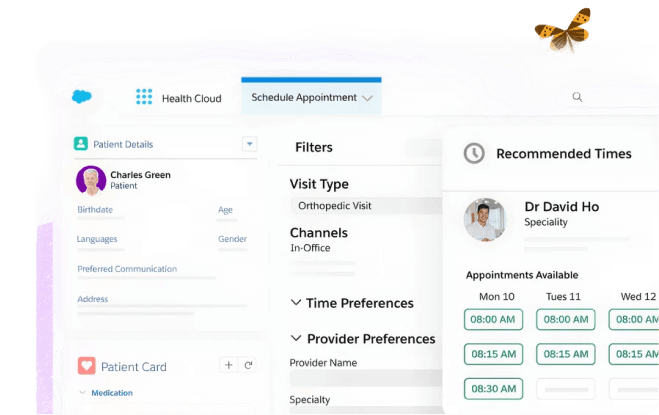
We unify clinical, non-clinical, and administrative data from every source into one patient or member profile. Care coordination and reporting rest on one accurate picture rather than five partial ones.

Our consultants build scheduling and routine inquiry agents that handle non-clinical questions, including appointment booking, prescription refill status, and billing queries, and escalate anything clinical to a person immediately. Agents never attempt to act on medical judgment calls, by design.
Hospitals and multi-site provider networks run on care coordination across departments, specialties, and locations. A patient moving between the emergency department, an inpatient stay, a specialist visit, and an outpatient follow-up passes through systems that were often bought separately and connected loosely.
At ProvidusCRM, we configure Health Cloud to hold that coordination together: patient records visible across integrated care systems (ICS) and departments, referral tracking that stops referral leakage, and care plans that stay current as different teams update them.
Payers deal with a specific pattern: members experience their plan and their care as disconnected. Enrolment happens in one system, claims processing in another, provider network directories in a third, and member engagement in whatever channel they last used.
Our consultants configure Health Cloud for payers with member engagement workflows connected to claims and eligibility data, so member service teams see the whole picture on the call. Enrolment, benefits verification, and care management flows sit in one system, reducing the disconnect members feel between their plan and their care.
Telehealth companies operate a healthcare model where the patient gets medical advice virtually. This shifts every operational assumption: scheduling, identity verification, clinical documentation, and follow-up all happen through digital channels.
At ProvidusCRM, we configure Health Cloud around virtual-first workflows: appointment scheduling optimised for time zones and provider licensing, virtual visit workflows integrated with the telehealth platform, and follow-up communication that reflects a healthcare relationship built entirely through devices.
Life sciences and pharma organisations manage patient support programmes and provider engagement across the product lifecycle, from clinical trial support through commercial operations.
Our consultants configure Health Cloud for these specific needs: patient support programme management with adherence tracking, provider engagement tracking, adverse event capture connected to safety reporting, and clinical trial support workflows. The configuration reflects the regulatory context these organisations operate under.
Home health and care management organisations deliver care outside a traditional clinical setting, which changes what “care coordination” actually means.
Our consultants configure Health Cloud for mobile-first care delivery. Care coordinators and field teams work from mobile devices, patient status updates happen in real time between visits, and family and caregiver communication sits inside the healthcare record.


ProvidusCRM provides you access to a team of experts holding certifications across the Salesforce ecosystem and having delivered successful implementations and solutions across healthcare providers, insurance, home health, telehealth, and life sciences organisations. We have enabled our clients to seamlessly connect Health Cloud to their systems, tools, and workflows while ensuring UK GDPR and DSPT-compliant access rules.







Our consultant leads your engagement with ProvidusCRM from project kick-off to go-live. They know your processes, challenges, priorities, security concerns, and compliance requirements. They stay on the account long enough to see what happens after launch.

You get a working session and a written summary each week. Any decision touching PID handling or access rules gets flagged and explained specifically. If a design choice has compliance implications, your compliance lead sees it before the build proceeds.
Before go-live, security and compliance approval happens as a defined milestone. Your compliance officer or Data Protection Officer (DPO) signs off on the patient data configuration in writing, so the audit trail exists from day one.

We schedule reviews to catch integration performance issues as EHR versions or healthcare protocols change. Health Cloud integrations need attention when the connected systems update, and that timing depends on your vendors' release schedules.

Neither, exactly. Salesforce provides the security and compliance foundation, including UK data hosting options, encryption, audit logging, and Salesforce Shield. However, UK GDPR and DSPT compliance depend on how the platform gets configured: access controls, data handling policies, and integration patterns. Our consultants configure Health Cloud against your specific compliance requirements.
Service Cloud handles general customer service. Health Cloud is built specifically for healthcare, with clinical data models (patient, care plan, condition, medication), healthcare-aware sharing rules, EHR/EMR integration patterns, and care coordination workflows out of the box. For a healthcare organisation, Health Cloud is almost always the right foundation, sometimes with Service Cloud alongside for non-clinical support.
Yes. Our consultants build integrations with Epic, Cerner, Athena, Allscripts, Meditech, Elation Health, and other EHR platforms. The integration approach depends on the EHR's supported protocols, your interoperability needs, and how much data needs to move in real time versus in batches.
FHIR (Fast Healthcare Interoperability Resources) is the healthcare data exchange standard. Health Cloud uses FHIR-aligned data models, so when your EHR speaks FHIR, integration is more straightforward and standardised. It does not eliminate integration work, but it makes the data structures compatible without heavy custom mapping.
Health Cloud has built-in data models for social determinants of health, so factors like housing stability, food security, transportation access, and social support get captured alongside clinical information. Care coordination workflows can then act on both together, which is often the entire point in complex care management.
Yes. Our consultants configure risk stratification models against your patient population, quality measure tracking for value-based care contracts, and population health reporting that surfaces to care teams at the point of care. This is one of the strongest use cases for Health Cloud beyond individual patient management.
A focused implementation runs twelve to twenty weeks. Complex projects with multiple EHR integrations, compliance frameworks, and multi-site rollouts typically run six to nine months. Our consultants give a realistic timeline after discovery, based on your actual integration landscape and care model.
A consultant advises on architecture, integration strategy, and compliance design. An implementation partner actually builds it. Our consultants deliver both together, so strategy and build never drift apart across the project.
Cost depends on scope, EHR integration complexity, compliance requirements, and whether ongoing managed services sit inside the engagement. A focused implementation can start in the mid-tens of thousands of pounds. Our consultants share a clear quote after discovery, based on your actual environment rather than a template.
Yes. Our consultants integrate telehealth platforms and remote monitoring devices with Health Cloud, so virtual visits, wearable data, and connected device readings flow into the patient record. Care teams then work from one view, whether the patient was seen in person, virtually, or monitored remotely.

20 August 2026

3 August 2026