Every nonprofit runs on programmes, but only a few can say who joined, what it cost, and what changed. This is the gap where good work often goes unseen, but strong nonprofit program management closes it. With the right Salesforce nonprofit consulting, organisations can use Salesforce to organise services, track participants, and measure outcomes effectively.
Let's understand how to organise services, participants, and outcomes in one place, so that you can see how the setup works, what to avoid, and which steps to follow first.
Why Do Spreadsheets Stop Working for Programmes?
Spreadsheets feel simple at the start, but then a second programme launches, three people hold three different versions, or even if a funder requests new figures, hours get disappeared into copying figures between multiple files, and mistakes slip in unnoticed.
The 2025 Charity Digital Skills Report has found that 45% of UK charities want help analysing data with AI tools on the other hand, 42% need help in telling stories with data. Along with this, Carleton University has found that 65% of charities call funder reporting a moderate to overwhelming burden, while only 8% manage it easily.
What Nonprofit Program Management Looks Like in Salesforce?
Think of Salesforce as one unified record for every programme you run, where each session, person, service, and result sits in one connected place, eliminating the extra work of rebuilding the picture by hand. With the right Agentforce consulting, nonprofits can streamline programme management and make better use of Salesforce automation.
Salesforce Nonprofit Cloud, now branded as Agentforce Nonprofit, includes tools for enrolments, programmes, service delivery, and outcomes. Goals, attendance, and notes can sit on the same participant record, allowing funders and staff to access the same facts and maintain a clearer view of programme performance.
Five Steps to Set Up Your Programmes
Following this order to build simple and also to keep data clean.
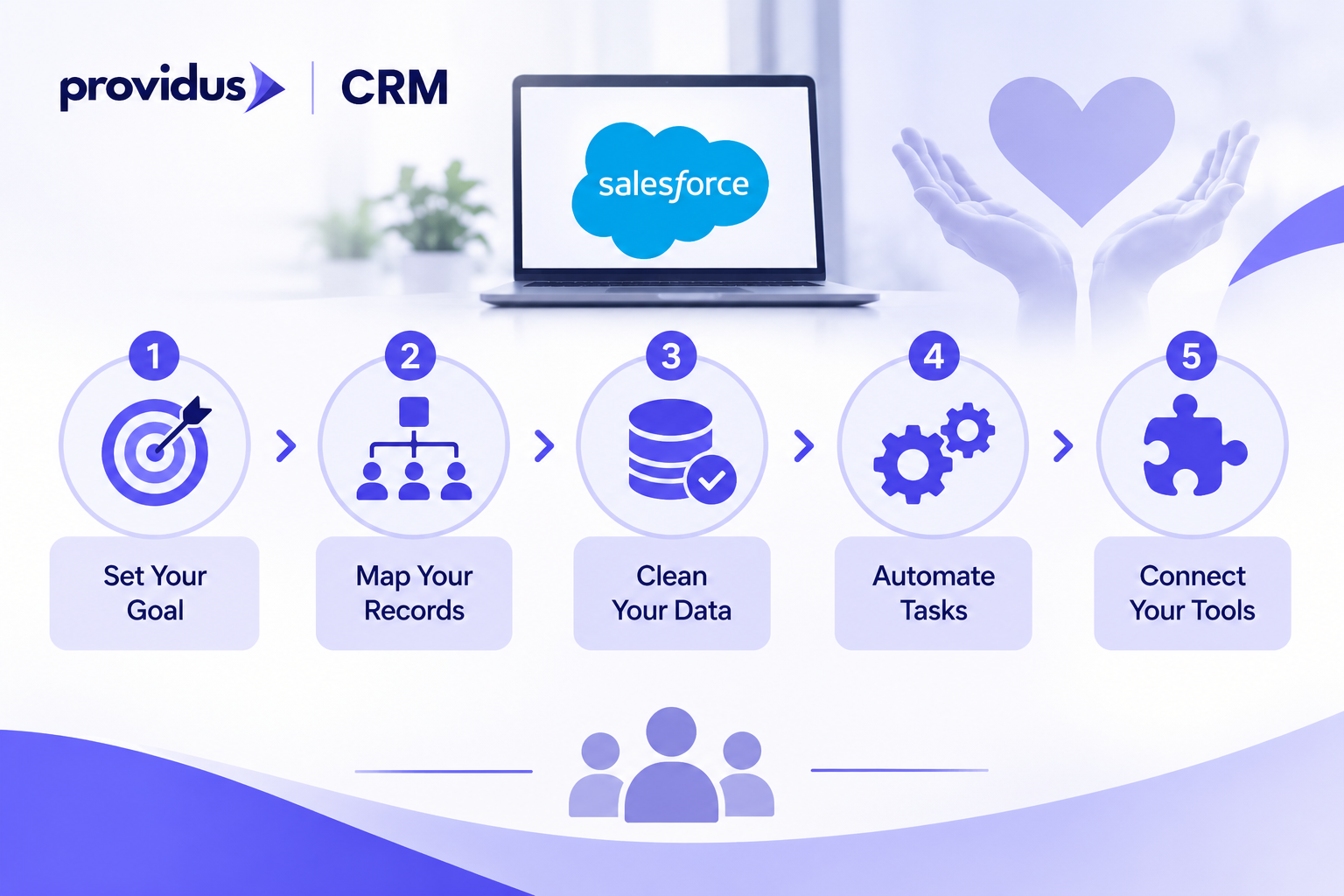
- Define each programme’s goal: Write one sentence on what should change and who you serve, then list three measurable outcomes.
- Map your records: Decide how participants, programmes, enrolments and services connect before building any fields.
- Bring your data in cleanly: Remove the duplicates rapidly, then load parent records before child records. Our Salesforce migration services should follow this exact sequence.
- Automate routine work: Use Flow to record attendance, send reminders, and flag participants who miss sessions.
- Connect your other tools: Link email, donation, and event platforms with Salesforce integration services so that fundraising and programme data can stay together.
Reporting Outcomes That Funders Trust
Reports are basically the reward for good setup. Once every service is logged against a participant, charity cloud computing can help nonprofits organise programme data and create dashboards that show attendance, progress, and results by programme in seconds.
Good nonprofit programme management is equal to reporting honestly. You should track outputs, for instance, sessions delivered, alongside outcomes, such as skills gained or improvements in wellbeing. Funders mostly trust the second kind because it directly shows changes, not just activity.
Moreover, keep your measures clear and limited. Three to five indicators per programme are easier to maintain than twenty, and staff are far more likely to record them consistently.
Five Mistakes That Slow Programme Teams Down
Here are five mistakes that work as hurdles, and if you keep them in consideration and avoid them, they will help you to work rapidly.
- Building too much too soon: Begin with one programme, prove it works, and then add the next.
- Skipping staff input: Frontline teams already know which fields are essential and which are only noise.
- Treating data entry as optional: A dashboard is the only as honest as the records behind it.
- Forgetting ongoing support: Without the regular reviews, fields drift, and reports lose trust. Salesforce managed services can mainly keep this in check.
- Ignoring data privacy: Limit access by role and with this review permissions regularly because the participant details are mostly sensitive.
Does Salesforce Show Multiple Records In One Unified Form?
Imagine a youth mentoring programme with 30 volunteers and 120 young people, and today, sign-ups live in one file, session notes in another, and outcomes in a funder form. In Salesforce, effective nonprofit program management gives every person one record.
Furthermore, attendance, mentor sessions, and confidence scores all attach to it, and volunteers see only what they need most and at the quarter end, the programme lead opens a dashboard rather than chasing files, and the funder report becomes a quick export.
As a result, staff stop retyping, and trustees finally see the same number as the team sees.
Who Should Own the Programme Data?
Tools do not run the programmes, people do, so give every programme a named owner who checks data quality each month and also decides which of the fields staff must complete. A Salesforce administrator should also look after permissions, fields and reports while the programme managers own the meaning of the data.
Furthermore, when both roles talk continuously, the system stays useful rather than becoming another place to type. Smaller teams mostly lack these skills, but our Salesforce Consulting Services start by reviewing how a programme actually runs, then shape Nonprofit Program Management around the reality instead of a template.
Six Signs Your Programmes Are Ready for Salesforce
Not every team needs a new system tomorrow. Count how many apply to your team today. If three or more of these sound familiar, it is probably time.
- Participant details sit in several files.
- Staff spend days assembling funder reports.
- Nobody can see the full journey of participants.
- Volunteers and partners need limited, secure access.
- Programme numbers differ depending on who you ask.
- Impact stories rely on memory, not records.
Plan Your Programme Setup with ProvidusCRM
Are you ready to bring order to your programmes? You can easily book a call with ProvidusCRM, a certified Salesforce partner, or even explore our Salesforce Nonprofit Consulting services for practical nonprofit program management.
We will be happy to start and help you to achieve your goals.
Conclusion
Programmes create change, and Salesforce helps you to prove it. You can start with one programme, connect people, services, and also outcomes in one record, and let clean data build your reports.
Remember, steady progress is a habit instead of a project, review your measures each quarter, listen to frontline staff, and also improve one process at a time. Every record you capture today will become evidence tomorrow, whether for a trustee meeting, a grant application or even a conversation with a donor.
Frequently Asked Questions
1. Can small charities get Salesforce at a lower cost?
Eligible charities can apply for free licences through Salesforce’s Power of Us programme.
2. How does Salesforce protect sensitive participant details?
Permission sets and field-level security limit who can view or edit sensitive details, which supports UK GDPR responsibilities.
3. Can volunteers or partner organisations update programme records?
Yes, Experience Cloud portals can give them limited access to only the records they need.
4. How long does it take to launch a first programme?
A single, well-scoped programme can mostly go live within a few weeks, depending on data quality and integrations.
5. Can Salesforce link one programme to several funders?
Yes, you can tag programme activity and outcomes by funder so each grant report draws on the right records.
6. Do we need a developer to track programmes?
Standard configuration and Flow cover most programme tracking, so developers are usually needed only for complex custom requirements.