

One month, you're celebrating a major windfall, the next, you’re looking at a stagnant donation portal and wondering where the funds went. That financial whiplash, the shift from feast to famine, is the daily reality for many in the charity sector.
The real challenge is not avoiding these swings altogether, but learning how to manage them with confidence. In fact, 68% of nonprofits rely on individual donations, which is pretty volatile when you think about it.
However, unpredictable doesn't have to mean unmanageable. Strong nonprofit revenue management is what separates organizations that survive from those that grow sustainably. Many organizations also strengthen their financial planning by investing in salesforce consulting services to gain better visibility into fundraising performance, donor trends, and revenue forecasting.
When nonprofits take control of their financial strategy, they turn uncertainty into opportunity and build lasting resilience. In this write-up, we will learn how to manage the highs and lows so your impact stays steady, no matter what.
What Drives Income Fluctuation in Nonprofits?
First of all, you should know that revenue swings are not a warning sign that something is wrong. They are a natural feature of nonprofit work. Since they rely on a varied mix of grants, donations, and earned revenue rather than steady sales, some instability over time is expected.
Research shows that nonprofit income is inherently uneven. On average, earned income accounts for nearly 70–75% of nonprofit revenue. At the same time, contributions account for only around 20%. Besides the rest comes from smaller streams, like events or investments. This mix of different resources may look perfect on paper, but in practice, each source has its complexities.
Donations, for example, are highly sensitive to external factors. According to Sage Journals, donations in the form of revenue are strongly tied to economic conditions. It explains why giving often spikes during year-end campaigns or good economic times, only to drop off quickly the moment uncertainty sets in.
Meanwhile, event-based fundraising and corporate sponsorships can fluctuate based on attendance, market conditions, and donor sentiment. At the same time, expenses rarely follow this irregular pattern. It’s a tough reality that just when communities need help the most, funding tends to dry up. Many nonprofits also use salesforce development services to build customized fundraising and financial management solutions that provide better visibility into changing revenue streams.
This imbalance between unpredictable income and growing expenses persuades leaders to make tough calls. They sometimes hit pause on programs, freezing hiring, or scrambling to reallocate limited funds.
To get your budget right, first accept how these funding patterns actually work. Once you realize that income ups and downs are built into the nonprofit world, everything changes. You can finally stop playing defense and start planning ahead.
Smart Strategies to Navigate Nonprofit Income Fluctuation
Break the Cycle of One-Source Funding
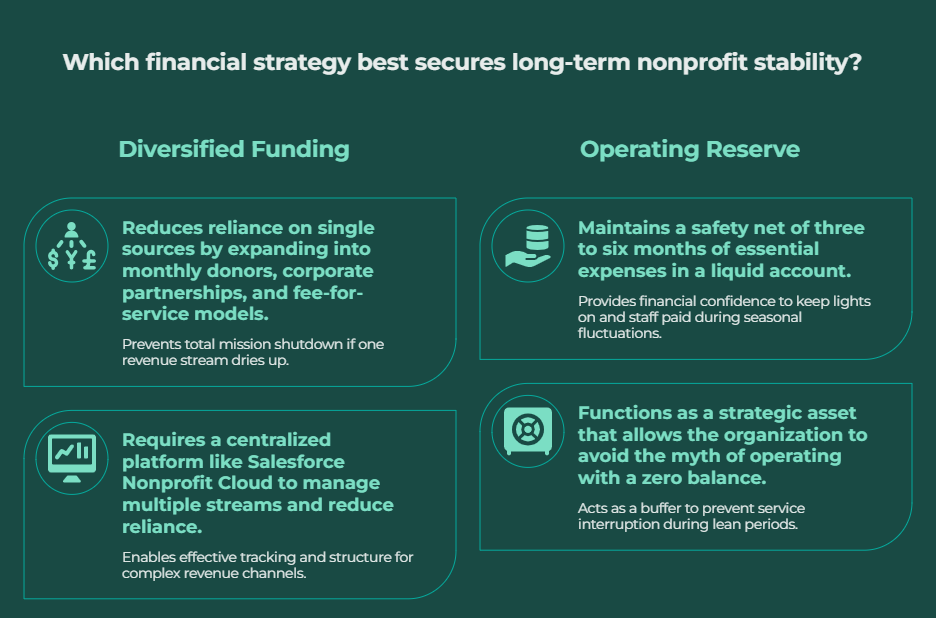
Relying on a single major donor, one big annual gala, or a lone government grant is essentially like walking a tightrope without a net. If that one source dries up or changes its priorities, your entire mission is suddenly at risk of a total shutdown.
To better handle revenue swings, you should expand your horizons to multiple independent channels. For instance, focus on building a robust base of monthly individual donors who provide a reliable financial floor or perhaps explore corporate partnerships that create actual shared value. Even more find success with fee-for-service models, like selling training manuals or mission-related products.
Leveraging a centralized platform, such as Salesforce Nonprofit Cloud consulting and implementation, can provide the structure to manage multiple streams effectively and reduce this reliance.
Prepare for Every Financial Curve
Traditional nonprofit budgeting often makes the mistake of assuming cash will flow in a perfectly straight line. Yet the reality is quite different. You need to move forward with a fluid strategy to address any inevitable peaks. Rather than clinging to a static annual document, we recommend creating three distinct versions of your financial plan:
- An optimistic version for when you exceed goals
- A realistic one based on historical data
- A contingency plan for a potential 20% drop.
A key component of this preparedness is using sophisticated forecasting tools, which a Salesforce Nonprofit Cloud implementation can provide to give you real-time visibility. Organizations transitioning from legacy systems can also benefit from Salesforce migration services to centralize financial and donor data, enabling more accurate forecasting and better decision-making.
Constructing an Operating Reserve
There is a persistent, lingering myth that nonprofits should always operate with a zero balance. If you share this perspective, you are only half right. Without a safety net, financial stability is difficult to maintain.
You should have a reserve fund covering around three to six months of essential expenses, held in a liquid account. This serves as a strategic asset that provides financial confidence and helps your nonprofit manage unexpected challenges.
If you face seasonal income fluctuations, you can tap into this reserve to keep the lights on and staff paid without interrupting essential services. Salesforce Nonprofit Cloud consultants can also help organisations track financial data, monitor fundraising performance, and gain better visibility into cash flow and donor trends.
Decode Trends with Data
Modern nonprofit revenue management now relies heavily on looking at historical trends. They dig into your data to spot the patterns, like months that are consistently dry or if there is a direct correlation between your marketing efforts and specific income spikes. Tracking Salesforce KPIs for nonprofits, such as donor retention, fundraising ROI, campaign performance, and recurring giving, helps organizations uncover these trends and make more informed financial decisions.
You act proactively and make data-driven decisions for the best mission impact. More interestingly, using this foresight, you can strategically align your major donor cultivation with potential funding dips to prevent financial strain.
Prioritize Your Existing Supporters
It is far cheaper to retain an existing supporter than to acquire a new one. Though you may find the rush of seeking a new donor exciting, the real success lies in retaining existing donors.
For this purpose, focus on radical gratitude. Send personalized videos, share impact stories, and show donors exactly where their money went. Let them feel like partners rather than ATMs. If it went well, there are strong chances of sticking around during lean years.
Modernize Your Tech Stack
Stop managing your donor data on a scattered collection of spreadsheets. Instead, modernize your Customer Relationship Management (CRM) system to automate routine tasks. The Nonprofit Cloud platform, for example, is specifically designed to unify data, allowing you to segment donors, track relationship health, and automate thank-you sequences the second a gift lands. Better tech means fewer revenue leaks and much more accurate data for your nonprofit budgeting.
Fix Short-Term Gaps
Even with great planning, surprises happen. If you find yourself in a tight spot, don't just ask for general support. Create a focused Bridge Campaign. It’s a fast-paced, focused effort to fix a particular, time-bound issue, such as waiting on a grant, and it keeps your mission moving forward.
Be specific with your community: "We have a $20,000 gap for the next three months due to a delayed state contract." People love solving specific problems. A strong bridge campaign transforms a funding gap into a chance for supporters to step up, bridging the gap to our next stable chapter.
Wrapping Up
Mastering the ebb and flow of funding means protecting the people and causes that rely on your work. Those who stop viewing income fluctuation as an unavoidable crisis and start seeing it as a variable to be managed will remain unstressed.
Be consistent in tracking finances, engaging donors, and adjusting plans when conditions change. Over time, these small but intentional actions create a strong financial foundation that supports long-term sustainability.
While these steps provide a powerful framework, the nuances of high-level nonprofit revenue management, such as complex tax implications, investment policies for reserves, and sophisticated data modeling, really call for specialized expertise.
Bringing in external experts, such as fractional CFOs or consultants, ensures your organization has the sophisticated oversight needed to build a durable financial foundation. When considering technology alignment, seeking dedicated Salesforce Nonprofit Cloud consulting can ensure your systems support your financial strategy seamlessly.
Frequently Asked Questions (FAQs)
1. Why do nonprofits experience revenue swings?
Nonprofits often rely on donations, grants, fundraising events, and corporate sponsorships, all of which can fluctuate due to economic conditions, donor behavior, seasonal giving, and funding cycles. Diversifying revenue sources and planning ahead can reduce the impact of these changes.
2. How can nonprofits prepare for unpredictable funding?
The best approach is to build a financial reserve, create multiple budget scenarios, diversify funding sources, and use data to forecast future revenue. Monitoring fundraising performance regularly also helps organizations respond before financial challenges become critical.
3. What is nonprofit revenue management?
Nonprofit revenue management is the process of planning, tracking, forecasting, and optimizing income from donations, grants, memberships, events, and other funding sources. Effective revenue management helps organizations maintain financial stability while continuing to deliver their mission.
4. How does Salesforce help nonprofits manage revenue?
Salesforce Nonprofit Cloud provides a centralized platform to track donors, fundraising campaigns, grants, and financial performance. It enables nonprofits to generate real-time reports, forecast revenue, automate donor engagement, and make informed financial decisions.
5. Why is revenue forecasting important for nonprofits?
Revenue forecasting helps nonprofits anticipate funding gaps, allocate resources effectively, and prepare contingency plans. Accurate forecasting reduces financial uncertainty and supports long-term sustainability.
6. What are the best ways to create a stable nonprofit income?
Organizations can improve financial stability by:
- Diversifying funding sources
- Strengthening donor retention
- Building recurring giving programs
- Applying for grants consistently
- Tracking fundraising performance with data
- Maintaining an emergency reserve fund
7. When should a nonprofit consider Salesforce consulting services?
A nonprofit should consider Salesforce consulting services when it needs to improve donor management, automate fundraising processes, migrate from legacy systems, or gain better visibility into fundraising performance and financial reporting.
8. How can ProvidusCRM help nonprofits improve financial management?
ProvidusCRM helps nonprofits implement, customize, and optimize Salesforce solutions that improve donor management, fundraising efficiency, reporting, and revenue forecasting. By centralizing data and automating key processes, organizations can make better financial decisions and focus more on their mission.
Ready to Build a More Financially Resilient Nonprofit?
Revenue uncertainty doesn't have to slow your mission. With the right Salesforce strategy, your nonprofit can improve donor management, forecast revenue more accurately, automate fundraising processes, and make data-driven decisions with confidence.
Whether you're implementing Salesforce for the first time, migrating from a legacy CRM, or optimizing your existing Nonprofit Cloud, ProvidusCRM is here to help you create a scalable solution that supports long-term growth.