
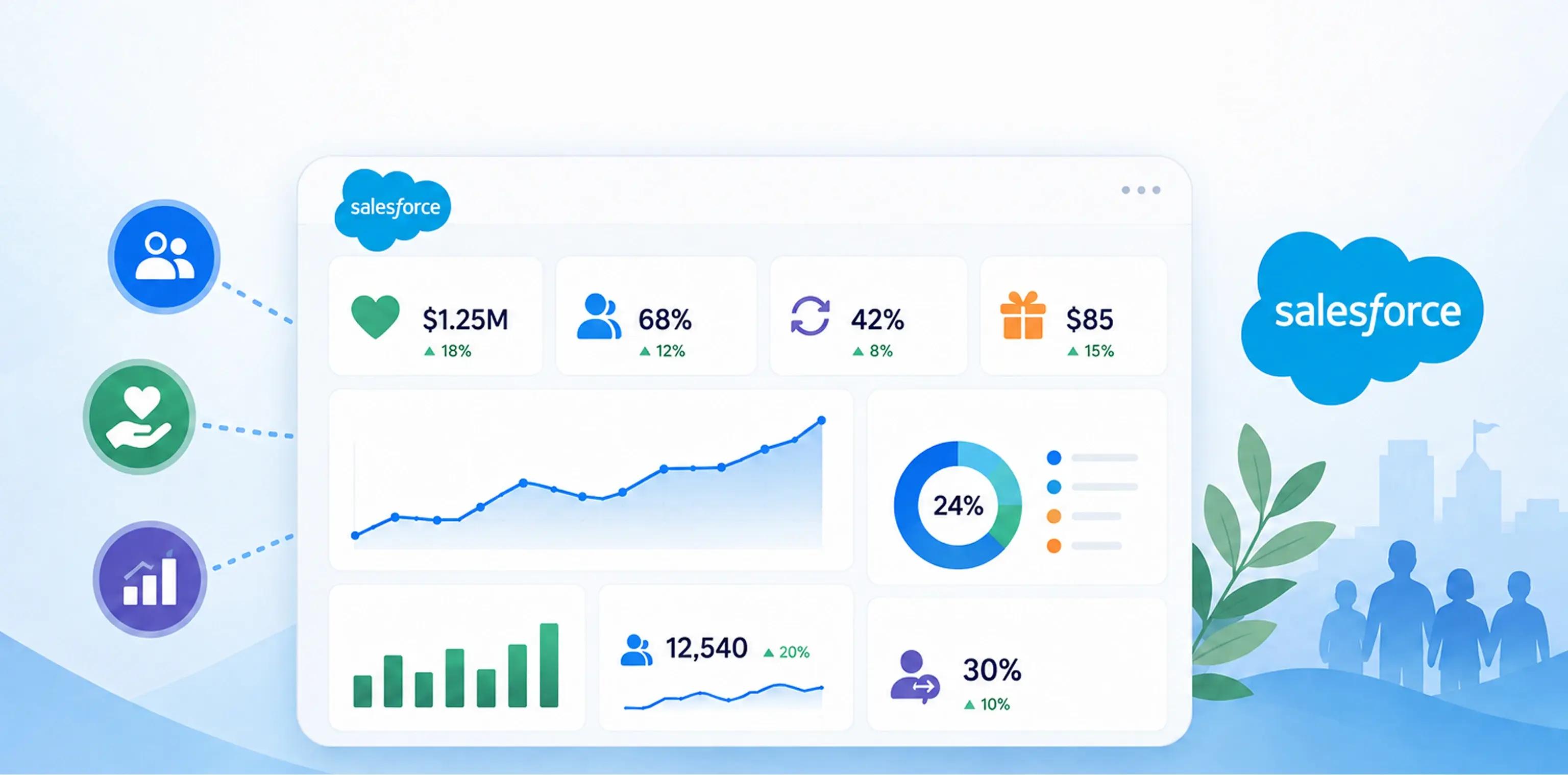
Data is the essential foundation of thriving nonprofits and what separates them from average ones. If you are ready to move beyond just collecting data, a professional Salesforce consulting services engagement combined with a successful Salesforce Nonprofit Cloud implementation can completely transform your operations.
Every single day, nonprofits collect vast amounts of data in the form of donor records, campaign performance, volunteer engagement, and program outcomes. According to Salesforce, nearly 90% of nonprofits collect data, but only around half actively use it to make strategic decisions.
To make the most of this information, you need more than spreadsheets—you need a high-definition dashboard that tells you exactly where your resources are going and what kind of impact they are creating.
This is where Salesforce stops being just a CRM and becomes a strategic growth platform. It transforms daily operational data into meaningful insights, enabling nonprofits to improve fundraising, strengthen donor relationships, optimize programs, and demonstrate measurable impact.
Instead of relying on assumptions, your organization gains the ability to respond quickly when campaigns underperform, invest more in successful initiatives, and provide donors with transparent evidence that every contribution creates real-world change.
By focusing on the right Key Performance Indicators (KPIs), nonprofits can build organizational resilience while earning greater donor trust through measurable, data-driven impact.
If you're struggling to make sense of your Salesforce reports, here are the nonprofit KPIs that deserve your attention.
Must-Track Salesforce KPIs for Nonprofits
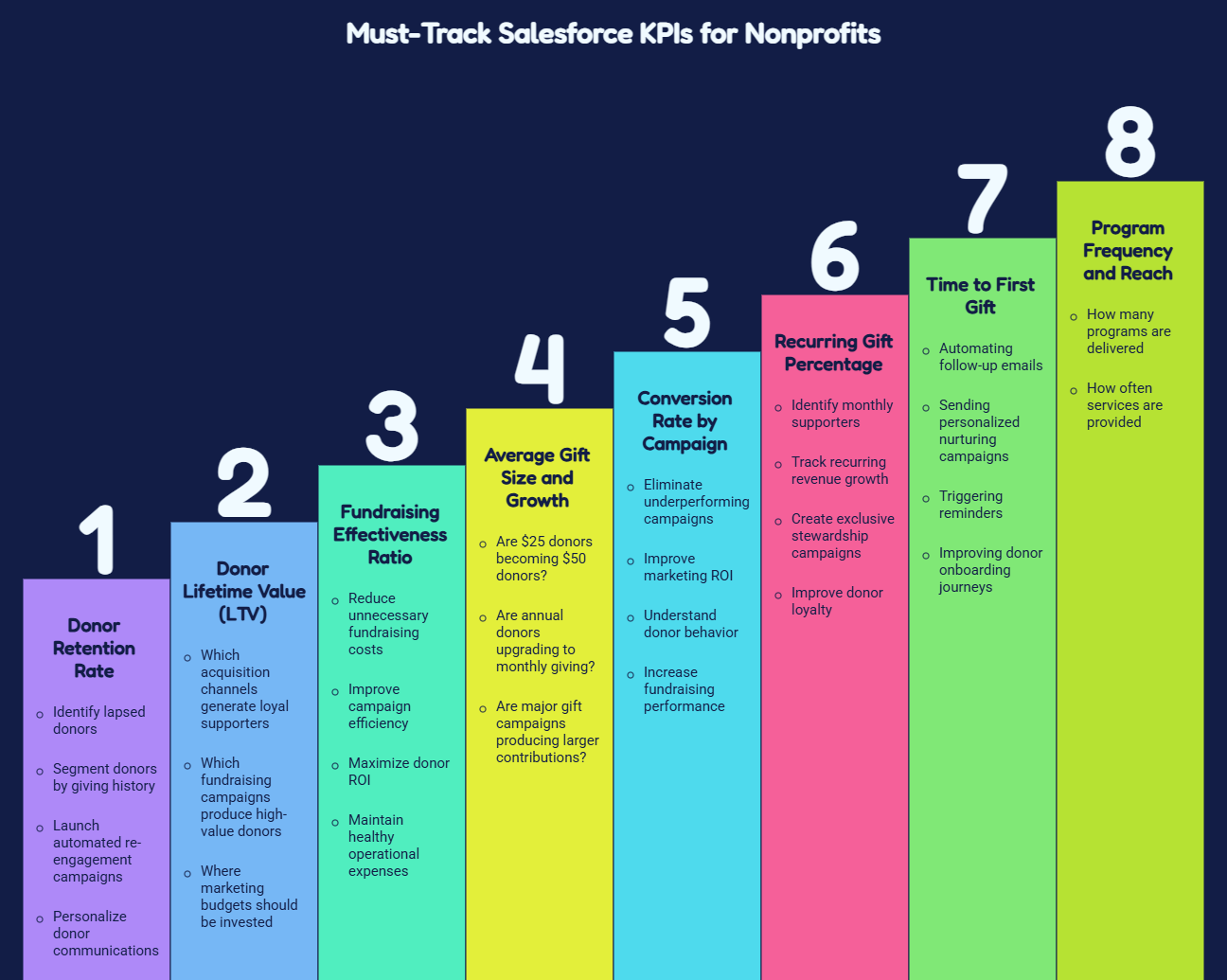
1. Donor Retention Rate
Not every donor contributes the same long-term value.
Donor Lifetime Value measures the total amount a supporter is expected to contribute throughout their relationship with your nonprofit.
Tracking LTV helps organizations determine:
- Which acquisition channels generate loyal supporters
- Which fundraising campaigns produce high-value donors
- Where marketing budgets should be invested
With Salesforce Nonprofit Cloud consulting, organizations can better track donor behaviour and identify which channels contribute the highest long-term value. Whether donors arrive through social media, email marketing, community events, or referrals, Salesforce helps identify the channels delivering the greatest impact.
2. Donor Lifetime Value (LTV)
Not every donor contributes the same long-term value.
Donor Lifetime Value measures the total amount a supporter is expected to contribute throughout their relationship with your nonprofit.
Tracking LTV helps organizations determine:
- Which acquisition channels generate loyal supporters
- Which fundraising campaigns produce high-value donors
- Where marketing budgets should be invested
Whether donors arrive through social media, email marketing, community events, or referrals, Salesforce helps identify the channels delivering the highest long-term value.
3. Fundraising Effectiveness Ratio
Every nonprofit wants fundraising dollars to create maximum impact.
The Fundraising Effectiveness Ratio compares fundraising expenses against the total funds raised.
Monitoring this KPI helps organizations:
- Reduce unnecessary fundraising costs
- Improve campaign efficiency
- Maximize donor ROI
- Maintain healthy operational expenses
According to fundraising industry benchmarks from the Association of Fundraising Professionals, tracking fundraising efficiency is considered one of the most important indicators of nonprofit financial health.
4. Average Gift Size and Growth
Every donation matters.
Monitoring your average gift size helps determine whether donors are increasing their contributions over time.
For example:
- Are $25 donors becoming $50 donors?
- Are annual donors upgrading to monthly giving?
- Are major gift campaigns producing larger contributions?
Salesforce dashboards make these trends easy to visualize and share with leadership and board members.
5. Conversion Rate by Campaign
Not every fundraising campaign performs equally.
Whether you're running:
- Giving Tuesday campaigns
- Peer-to-peer fundraising
- Annual galas
- Email campaigns
- Social fundraising
you should know exactly which campaigns convert supporters into donors.
Campaign conversion tracking helps nonprofits:
- Eliminate underperforming campaigns
- Improve marketing ROI
- Understand donor behavior
- Increase fundraising performance
6. Recurring Gift Percentage
Recurring donors create predictable revenue that helps nonprofits plan confidently.
This KPI measures the percentage of donors enrolled in monthly or recurring giving programs.
Within Salesforce reporting dashboards, nonprofits can:
- Identify monthly supporters
- Track recurring revenue growth
- Create exclusive stewardship campaigns
- Improve donor loyalty
Recurring donors often become some of the highest lifetime value supporters.
7. Time to First Gift
How long does it take for a prospect to become a donor?
Time to First Gift measures the period between a person's first interaction with your nonprofit and their initial donation.
If this timeline is too long, potential donors may lose interest.
Salesforce automation helps shorten this process by:
- Automating follow-up emails
- Sending personalized nurturing campaigns
- Triggering reminders
- Improving donor onboarding journeys
8. Program Frequency and Reach
Fundraising is only half the story.
Your impact matters just as much.
Program Frequency and Reach measure:
- How many programs are delivered
- How often services are provided
- How many individuals benefit
Combining fundraising data with program delivery allows nonprofits to demonstrate exactly how donor contributions translate into measurable community impact.
9. Lapsed Donor Re-engagement Rate
Every nonprofit loses donors.
The important question is:
How many come back?
Tracking your Lapsed Donor Re-engagement Rate allows you to identify supporters who haven't donated within the past 12–24 months and reconnect with personalized campaigns.
Simple "We Miss You" emails, impact updates, or campaign invitations often encourage previous donors to return.
Salesforce segmentation makes these campaigns highly targeted and significantly more effective.
How Salesforce Makes KPI Tracking Easier
Tracking nonprofit metrics manually quickly becomes overwhelming.
Salesforce serves as a centralized platform that combines donor records, fundraising campaigns, volunteer management, grant tracking, and program performance into one unified system.
With advanced dashboards, automation, and reporting, nonprofits can easily monitor organizational performance.
Dynamic Dashboards
Replace static monthly spreadsheets with real-time dashboards that continuously update your KPIs.
Automated Reporting
Generate executive-level reports within minutes instead of spending hours compiling data manually.
Identify Growth Opportunities
Historical comparisons reveal:
- Emerging donor trends
- Successful fundraising channels
- High-performing campaigns
- Areas requiring improvement
Make Better Decisions
Instead of relying on assumptions, nonprofits can confidently allocate budgets, improve campaigns, and maximize mission impact using data-backed insights.
Organizations looking for advanced CRM capabilities often combine these reporting features with professional Salesforce development services and tailored Salesforce customization services to align Salesforce with their unique fundraising and operational workflows.
Why Measuring KPIs Matters
Data alone doesn't improve nonprofit performance.
The value comes from understanding what the data is telling you.
When organizations consistently monitor KPIs, they can:
- Increase donor retention
- Improve fundraising ROI
- Build stronger donor relationships
- Demonstrate measurable impact
- Improve board reporting
- Strengthen grant applications
- Make faster strategic decisions
According to Giving USA, charitable giving continues to evolve each year, making data-driven decision-making increasingly important for nonprofits.
Frequently Asked Questions
What are the most important Salesforce KPIs for nonprofits?
The most important KPIs include donor retention rate, donor lifetime value, fundraising effectiveness ratio, recurring donor percentage, campaign conversion rate, average gift size, program reach, and lapsed donor re-engagement rate.
Why should nonprofits track donor retention?
Retaining existing donors is generally more cost-effective than acquiring new ones. A strong donor retention rate also indicates healthy donor engagement and long-term organizational sustainability.
How does Salesforce help nonprofits measure impact?
Salesforce centralizes donor, fundraising, volunteer, and program data into one platform, allowing nonprofits to create real-time dashboards, automate reports, and monitor organizational performance through customized KPIs.
Can Salesforce automate nonprofit reporting?
Yes. Salesforce can automatically generate dashboards, donor reports, fundraising summaries, campaign performance reports, and executive-level analytics, reducing manual reporting time significantly.
Do small nonprofits benefit from Salesforce?
Absolutely. Small nonprofits can use Salesforce to improve donor management, automate communications, track fundraising performance, and make informed decisions without needing large administrative teams.
Conclusion
Nonprofit success requires far more than passion—it demands measurable impact, operational efficiency, and informed decision-making.
By focusing on essential Salesforce KPIs such as donor retention, fundraising efficiency, recurring giving, campaign performance, and program reach, nonprofits gain a clear understanding of what's working and where improvements are needed.
Rather than simply collecting data, successful organizations use it to strengthen donor relationships, optimize fundraising strategies, and demonstrate transparent outcomes to boards, grant providers, and supporters.
With the right Salesforce strategy, your nonprofit can transform raw information into meaningful insights that drive long-term growth and greater community impact.
Ready to Build a Data-Driven Nonprofit?
At ProvidusCRM, we help nonprofits unlock the full potential of Salesforce with tailored CRM solutions, intelligent reporting dashboards, and automation designed around your mission.
Contact ProvidusCRM today to discover how our Salesforce experts can help your organization improve fundraising performance, strengthen donor relationships, and maximize your social impact.