

Choosing between an internal deployment and specialized technical expertise is a critical decision for growing sales organizations. It impacts your rollout timeline, technical risk, and long-term data architecture. Making the wrong choice often leads to months of costly system rework.
This is why SMBs, nonprofits, and enterprises engage a Salesforce consultant before modifying platform settings. Securing specialised guidance early supports a successful CRM implementation while preventing data loss, user resistance, and scope creep from derailing system deployment.
Why Salesforce CRM Implementations Fail?
Salesforce implementations rarely fail due to platform limitations. They fail because of unclear governance, flawed sequencing, and rushed configuration decisions. Salesforce is engineered to scale reliably to enterprise volumes when built on sound architecture.
Research from Zippia found that 91% of companies with ten or more employees now run some form of CRM system, yet a significant share never realise the return they have expected from it. The same research notes that a properly implemented CRM can even lift sales productivity by as much as 50%, which reflects how wide the gap is between average and well-run projects
Separately, data compiled by SmallBizGenius shows us that sales representatives spend only 17.9% of their working time actually using their CRM system, with much of the remainder lost to manual spreadsheet work. The platform was meant to eliminate this gap between actual usage and adoption, but it is exactly where expert guidance earns its keep.
Failed implementations manifest as untrusted analytics dashboards, duplicate account records, and reps defaulting to local spreadsheets. Remediating these issues post-launch costs significantly more than configuring the system correctly from day one.
Why Hire a Salesforce Consultant Before System Configuration?
While basic Salesforce administration is low-code, creating declarative automation logic, i.e., Flow Builder, designing scalable data schemas, and setting security profiles that support multi-year growth require experienced technical architecture.
Research published on Shopify's enterprise blog has cited 2024 findings from the Project Management Institute, which found that only 48% of companies rate their implementation projects as genuinely successful in delivering the value they were funded to deliver. The remainder land somewhere between outright failure and mixed results, usually because coordination, scope, and user adoption broke down along the way.
A consultant bridges this gap. Engaging a Salesforce implementation partner early resolves schema flaws and data quality issues during architectural design, when fixes are simple, rather than inside a live production org.
Core Business Benefits of a Salesforce Consultant
The benefits of a Salesforce consultant go well beyond faster configuration. A consultant brings pattern recognition from multiple prior projects, which means they can flag a flawed data model or even an unrealistic automation plan before it becomes a live problem.
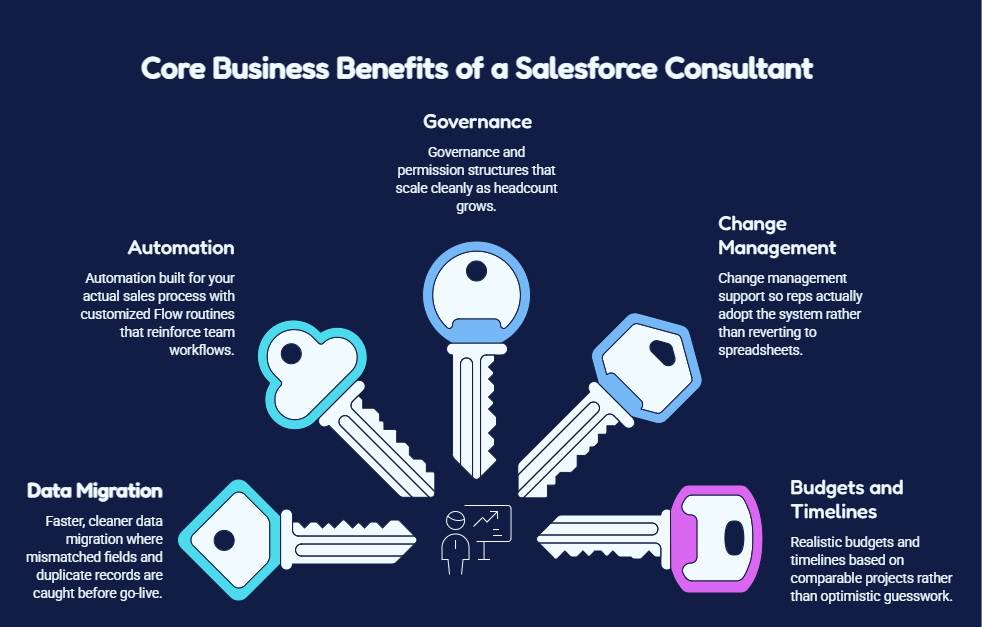
In practical terms, working with an experienced consultant means:
- Faster, cleaner data migration: mismatched fields and duplicate records are caught before go-live rather than after.
- Automation built for your actual sales process: customized Flow routines that reinforce team workflows
- Governance and permission structures: that scale cleanly as headcount grows, instead of being rebuilt every year.
- Change management support: so reps actually adopt the system rather than silently reverting towards the spreadsheets.
- Realistic budgets and timelines: based on comparable projects rather than optimistic guesswork.
A study cited by CRM research aggregator 4CRMs, which draws on HubSpot survey data and Statista, found that 42% of respondents pointed to a lack of implementation expertise or even proper training as the core reason their CRM rollout never became fully successful. This single statistic is arguably the clearest case for outside expertise available.
What an Enterprise Salesforce Implementation Partner Provides
A dedicated Salesforce implementation partner brings broad technical pattern recognition, having resolved complex data migration, API integration, and user governance challenges across multiple enterprise rollouts. Their expertise in Salesforce integration services ensures business systems connect seamlessly while maintaining data integrity and long-term scalability.
Enterprise Salesforce consulting spans four distinct technical phases: discovery and business architecture, custom build and middleware integration, change enablement, and post-launch hypercare. Generalist internal IT teams rarely possess the full breadth of these specialized skills.
The strongest partners are also transparent about trade-offs. They will tell you when a "quick win" automation will cause maintenance headaches in eighteen months, rather than simply starting to build whatever is requested. This kind of judgement only comes from experience, not from a certification badge alone.
Implementation Best Practices Our Certified Consultants Follow
Regardless of company size, the best practices of Salesforce implementation a consultant eventually follows is a broadly consistent pattern. A consultant applies these as standard and not as optional extras layered on at the end of a project.
The core practices include:
- Defining clear, measurable objectives even before any configuration begins, so success can actually be assessed later.
- Assigning a named data owner and also a Salesforce-side steward, so decisions do not stall for lack of ownership.
- Cleansing, deduplicating, and mapping source data schemas using automated ETL tools before loading.
- Staging and validating configurations inside a dedicated sandbox using representative enterprise data sets.
- Rolling out in phases, with each phase validated before it gets started.
- Engineering a structured deployment and rollback plan to ensure zero data loss during production release.
If these practices are applied consistently, they are what separate a rollout that becomes an asset from one that quietly becomes shelfware within a year.
Salesforce Implementation Strategy for First-Time Deployments
Salesforce implementation for beginners looks very different from an enterprise migration, and a good consultant will scale their approach systematically rather than applying an enterprise playbook to a ten-person sales team.
For a first-time implementation, you should expect an initial discovery phase to map your current sales process, a scoped build focused on the automations and objects you will actually use, hands-on training for your team, and yes, a defined hypercare period immediately after go-live. Smaller organizations rarely require advanced enterprise features on day one. An experienced consultant right-sizes the initial build to prevent unnecessary technical debt.
If this is your first CRM project, you should ask your consultant to explain each configuration decision in plain terms before it is built. A partner who cannot even justify why an automation or field exists in language your team understands is usually building complexity you will struggle to maintain later.
Why Partner with ProvidusCRM for Your Salesforce Deployment
A genuinely seamless Salesforce implementation is the product of clean data, disciplined scoping, phased delivery, and a team that has done this before, not luck or a generous budget alone. This discipline is exactly what a qualified Salesforce consultant for seamless CRM implementation brings to a project from day one.
ProvidusCRM’s certified Salesforce solution architects deliver end-to-end CRM transformations across financial services, logistics, and the nonprofit sector. Explore ProvidusCRM's Salesforce Implementation Services to schedule an architectural discovery session with our technical team.
Conclusion
Salesforce ROI is driven by data discipline, system architecture, and user adoption rather than just licensing. Engaging a qualified Salesforce consultant early transforms rollout risk into a controlled, repeatable process.
If this is done well, the result is not just a system that technically works, but it is one your sales team actually trusts and uses every day, this is ultimately the only measure of success that matters.
Frequently Asked Questions
1. Do small businesses really need a Salesforce consultant, or is that only for enterprise rollouts?
Even small teams benefit, since a consultant can right-size the build so you are not paying to maintain features you will never use.
2. How long does a typical Salesforce implementation take with a consultant?
Small implementations mostly take two to four weeks, mid-sized projects run six to twelve weeks, and enterprise rollouts can take three to six months.
3. What is the biggest risk of implementing Salesforce without expert help?
Poor data quality and even unclear ownership are the most common causes of failure, not the platform itself.
4. Can a consultant help migrate data from an existing CRM into Salesforce?
Yes, and this is usually where a consultant's experience matters most, since mismatched data or dirty data is the leading cause of post-launch problems.
5. What should I look for when I hire a Salesforce consultant?
Look for relevant certifications, evidence of projects in your industry, and a clear, honest answer on realistic timelines rather than the fastest quote.