
Every volunteer hour, gift, and campaign your charity has ever run always leaves a trace in your data, but in multiple organisations, those traces sit in inboxes, spreadsheets, and old databases. So, the important question to ask is: why are more charities shifting to nonprofit CRM consulting?
The answer is that buying software is easy, but yes, making it fit your objectives is hard. A consultant closes this gap before time, money, and goodwill are lost. Let’s understand what role that really involves.
What Does a CRM Consultant Actually Do for a Charity?
A CRM consultant analyzes and studies how your team works today and after that designs a system around it, after this they map your donor journey, clean your records and mainly decide which tools belong in the platform. Remember, the aim is a setup that your staff genuinely want to use.
Furthermore, good advice also covers what not to build; multiple charities pay for features they mainly never switch on, and with this, basic requirements, for instance, Gift Aid tracking, stay unmet. A consultant helps you spend on what actually matters the most.
Consultants basically act as a translator, and fundraisers speak in donors and campaigns while the developers speak in fields and objects. A consultant bridges the two so that no one gets confused in the build process.
Why Do Charities Struggle Without Expert Guidance?
Apart from money, direction is also the problem. The Charity Digital Report 2026 has stated that almost half of charities 49% say their chief executive requires a clearer vision of what digital could achieve for them. With this, reporting on the 2025 survey, Digital noted that half of charities 49% have planned to prioritise a strategy for data, AI and digital in 2026. The objective is clear, but a plan to match it is always lacking.
This is the point where Nonprofit CRM consulting gets its place because strategy should come before configuration and an outside expert asks the awkward but main question early, for instance, which decision should your data support and who owns each record?
What Goes Wrong When Planning Is Skipped?
Small gaps at the beginning can convert into larger problems later, a missing field means a report that never gets balanced, or an unclear owner means duplicate records that nobody feels responsible for cleaning.
Staff actually notice first, when the system feels slower than a spreadsheet, people silently go back to their old habits, and then data quality follows, adoption drops, and the new platform becomes an expensive address book. In this context, basically, planning prevents this pattern and also protects your budget. A short discovery phase also exposes weak spots while they are also cheap to fix.
Five Signs You Should Take as a Sign to Contact a Consultant
Not every charity needs outside help from the first day, you should take these as warning signs:
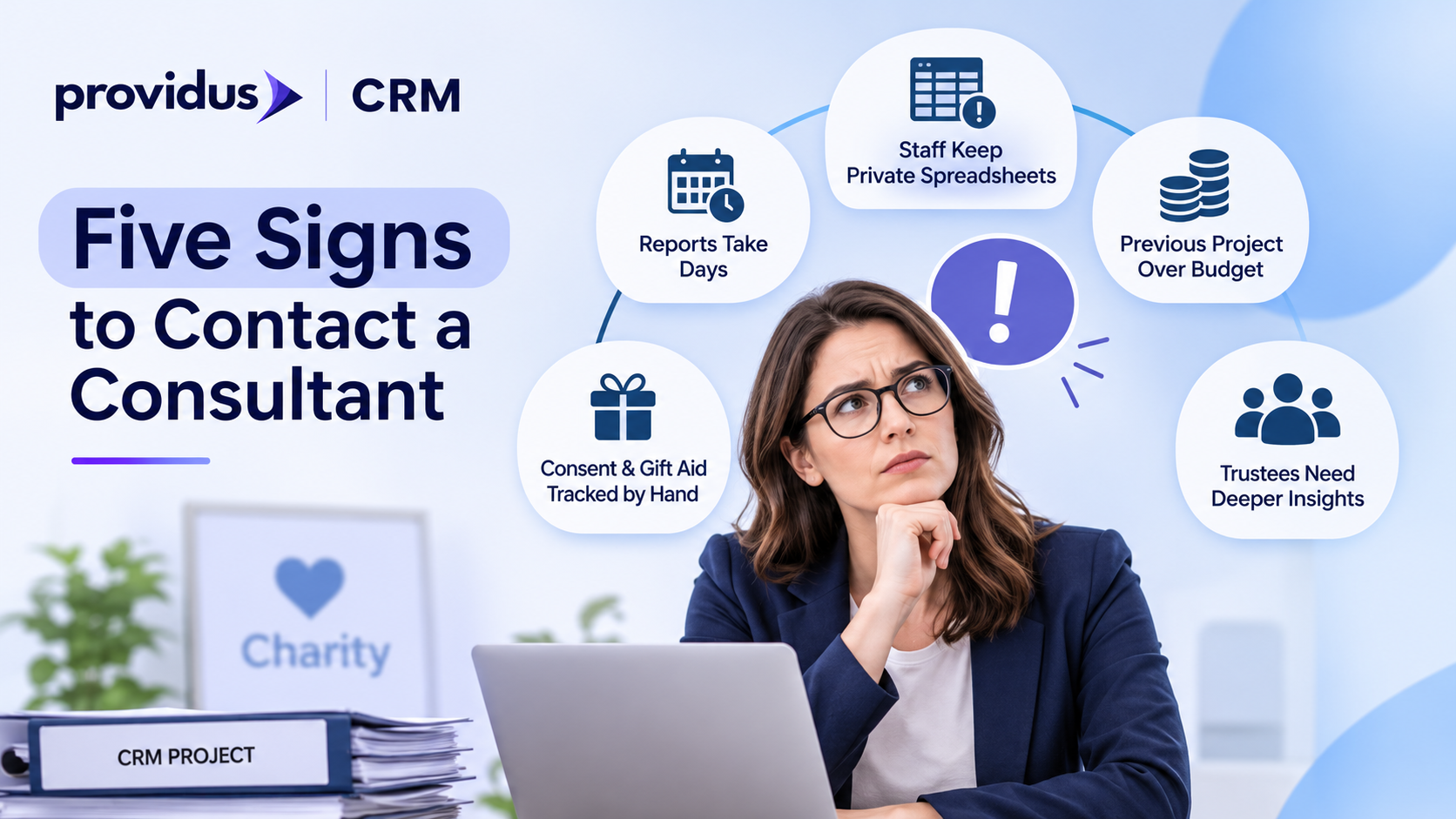
- Reports take days to produce and still disagree.
- Staff keep private spreadsheets.
- A previous CRM project ran over budget or got stalled.
- Consent and Gift Aid details are tracked by hand.
- Trustees ask for the insight that your system cannot provide.
Moreover, spotting even two of these mainly gives a message that the cost of waiting is higher than the cost of advice, and in this scenario, you should not wait for the crisis because a calm review now is far more cheaper than an emergency rescue later.
How Does a Consulting Project Usually Unfold?
Most of the nonprofit CRM consulting projects follow a structured clear path that basically keeps surprises to a minimum, the steps that are mentioned below are the pathway:
- Discovery: the consultant interviews staff and reviews your current data.
- Design: priorities, fields, and processes are agreed in plain language.
- Build and test: the system is configured, then checked with real records.
- Training and review: staff learn the system, and early results are measured.
Each stage ends with a decision point, so that you can approve what has been done before the next stage begins.
What Changes After a Consultant Joins?
As the work begins, within weeks the noise usually drops. Duplicate records are merged, fields are renamed in plain language, and the dashboard shows the same number to everyone. Along with this, fundraisers stop asking where data live and start asking related to what it means.
With this, compliance improves too, suppression, consent, and Gift Aid details sit in structured fields, so that your team can automatically answer supporter requests, and trustees also gain reports they can trust.
Furthermore, confidence grows as well, leaders can compare campaigns, forecast income, and also show funders clear evidence related to impact. There are multiple benefits ahead because a certified Salesforce partner can easily configure Nonprofit Cloud related to your programmes, from donor lifecycles to grant tracking.
How Do You Choose the Right Consultant?
Begin with a proof, ask for charity case studies, named certifications, and also references from teams of your size, for instance, a consultant who has never met trustee reporting or Gift Aid will learn on your budget.
Next step, check how they can handle handover, the best partner will train your staff, document every decision, and also stay available through Salesforce Managed Services. You should never feel locked in, and after this, look at their approach related to moving data.
Year of record migrations require careful planning, so Salesforce Migration Service should be part of the conversation from the initial call. At the end, you should ask questions related to communication, plain language, regular updates, and also honest advice related to risks because this matters more.
Ready to Get Your Supporter Data Working Harder?
If your team is rescuing an existing platform or even weighing a new platform, speak to our specialists who know the sector. ProvidusCRM basically offers practical Nonprofit Consulting with certified Salesforce experts.
ProvidusCRM is a certified Salesforce partner for nonprofits, helping charities and welfare organisations streamline donor management, grantmaking, and fundraising. We ensure Salesforce becomes a driving force towards making the maximum impact for your mission.
Conclusion
Charities hire a CRM consultant to turn your scattered data into more confident decisions. This role brings clean records, strategy, compliance, and also training together in one package. You should start with an honest review of how your data works today and then choose a partner who listens before they build.
Remember, a consultant does not replace your team, but they equip it. With the right partner, your supporter data stops being a storage problem, and it also becomes your strongest fundraising asset.
Frequently Asked Questions
1. How much does a CRM consultant cost for a small charity?
Costs vary by scope, but many consultants offer fixed-price discovery workshops, so ask for one before committing.
2. Can a consultant work alongside our in-house team?
Yes, most work as an extension of your team and hand over documentation and training.
3. How long does a typical consulting engagement last?
A discovery phase mostly takes a few weeks, while full projects depend on size and complexity.
4. Will a consultant need access to our supporter data?
Only as much as the work requires, access should be limited, logged, and covered by a data processing agreement.
5. Can a consultant help us prepare for AI features such as Agentforce?
Yes, they can first assess data readiness, since AI results depend on clean, well-structured records.
6. Should we hire a consultant before choosing a platform?
Yes, independent nonprofit CRM consulting before buying will help you to compare options against your actual needs.