
Every nonprofit runs on the efforts of people who sign up, show up, and also silently lose when nobody follows up with them properly. It is hardly a shortage of volunteers that hurts a charity, but it is the absence of a system that should be there to organise them, and this gap grows silently until it becomes impossible to ignore.
Choosing between multiple options can make you feel overwhelming, especially when most of the vendor websites express themselves in almost identical terms. The main element is to set noise aside and look specifically at the element that separates useful and impactful volunteer management software for nonprofits from a tool that only looks good in a demo. For organisations considering a broader Salesforce-based nonprofit technology strategy, Salesforce nonprofit consulting can also help align volunteer management with wider charity operations.
Why Volunteer Management Software Is a Necessity for Nonprofits Now?
Volunteering in the UK is not based on interest, but it is mainly based on structure. Community and Engagement Survey shows that 18% of adults in England took part in formal volunteering at least once a month in 2025/26.
While this represents a modest increase on the previous year, managing these volume shifts requires structured coordination.
The problem is that most charities still coordinate this activity through group chats, spreadsheets, and memory. This approach can work with ten volunteers, but it buckles at fifty, and then it becomes a genuine operational risk at five hundred. Research from the Royal Voluntary Service reports a shortfall of up to three million volunteers across the UK in 2026, also mentioning that 164 million extra volunteering hours can be available every month only if the opportunities can be digitally accessible.
Important points of Volunteer Management Software for Nonprofits
Not every platform that is marketed at charities is normally built for how charities mainly operate day-to-day. The main element is to know which features actually reduce admin instead of adding another login for the team to manage. Let’s understand the impactful features that actually make a difference.
1. Shift Scheduling And Rotation Management
Volunteers should be able to see open slots, receive automated reminders without a coordinator to chase anyone by email or phone, and book themselves for any voluntary work.
2. Skills and Availability Tracking
A searchable record of who is DBS checked, when they are free saves hour furing seasonal appeals, emergency call-outs, and busy campaigns and what training they hold.
3. Hour Logging and Impact Reporting
Funders now expect proof of volunteer contribution, so also built in hour tracking can turn into ready-made reporting for annual reviews, trustees, and grant applications.
4. Integration With Your CRM
Volunteer data should always sit alongside beneficiary and donor records and not in a separate isolated system that nobody remembers to update.
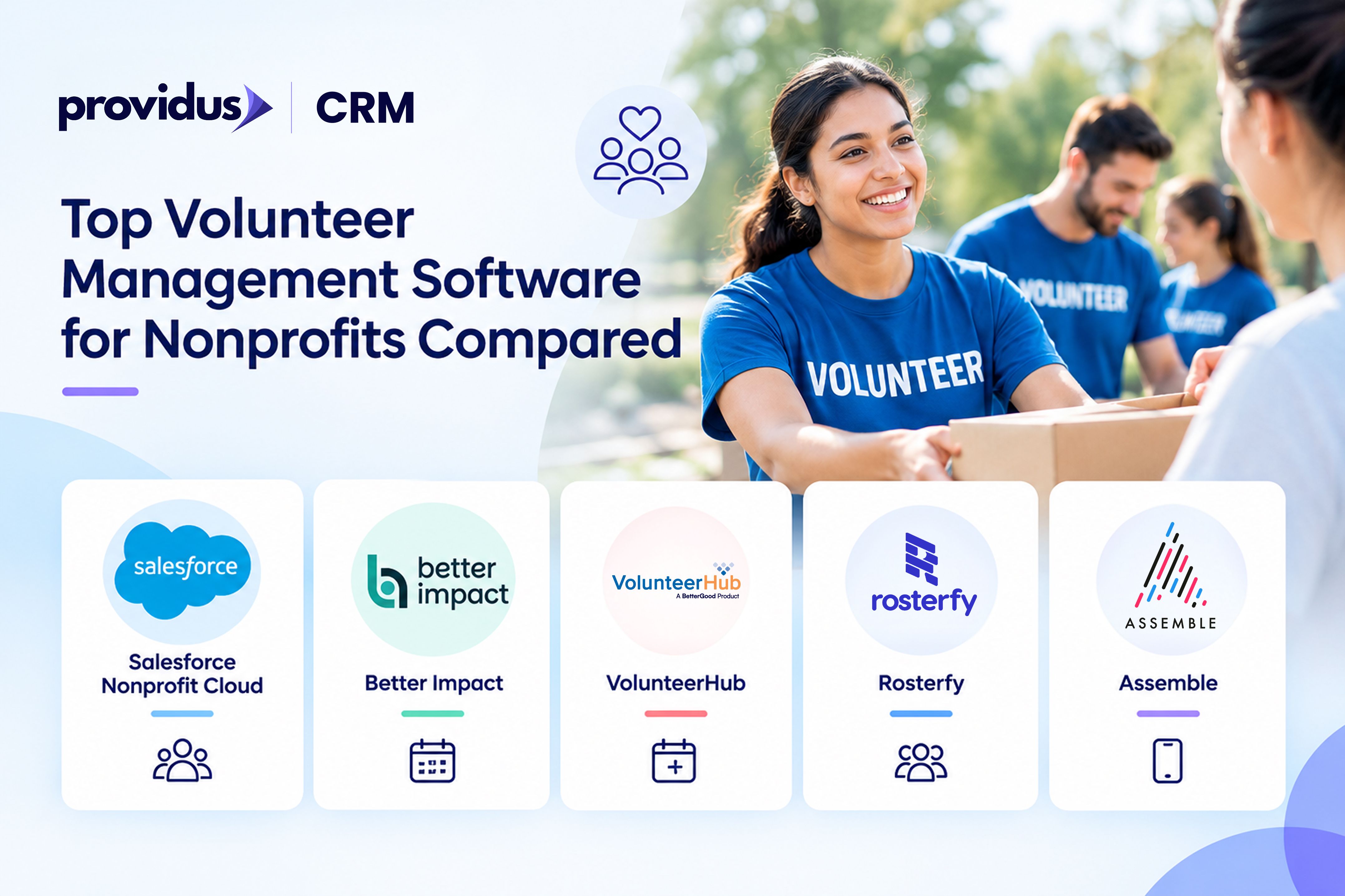
Top Volunteer Management Software for Nonprofits Compared
Here is how some of the most established options in this space compare on the essentials that matter most to a small or mid-sized charity team, rather than on marketing claims alone.
| Software | Good for | Standout Feature | CRM Integration |
|---|---|---|---|
| Salesforce Nonprofit Cloud | Unified supporter management | Single data model across donors, programs, and volunteers | Native unified database |
| Better Impact | Health, social care and screening-heavy programmes | In-depth screening and also compliance tracking | Available via add-on integrations |
| VolunteerHub | Frequent, high-volume events | Simple calendar-based sign-up pages | Limited native integration |
| Rosterfy | Large-scale event and festival volunteering | Mass onboarding for short-term events | Available via add-on integrations |
| Assemble | Mobile-first community networks | Mobile app onboarding and internal communications | Requires API / middleware |
- Salesforce Nonprofit Cloud: Native volunteer management avoids data silos by housing volunteer history, skill profiles, and logged hours on the same unified data architecture as fundraising, grants, and program delivery. This unified view gives teams full visibility into a supporter’s complete lifecycle, eliminating the need for continuous cross-system reconciliation.
- Better Impact: It is a long-standing specialist tool that is well suited to organisations whose primary need is screening and scheduling large volunteer pools, especially for social care, health and emergency response settings.
- VolunteerHub: It offers straightforward sign-up pages and also calendar-based scheduling for charities that run high-volume events without much internal IT support.
- Rosterfy: It was built for large-scale event volunteering, for instance, festivals and sporting fixtures, and still performs impactfully whenever mass coordination is the priority over long term relationship tracking.
- Assemble: It position as a lighter, mobile-first option for younger and community-based volunteer networks who basically expect an app-like experience instead of a traditional desktop portal.
Why Many Nonprofits Settle on Salesforce for Volunteer Management?
Choosing standalone volunteer management software for nonprofits mostly solves one problem while silently creating another: a second system that needs its own logins, its own reports, and its own reconciliation against your primary CRM every month.
Salesforce Nonprofit Cloud mainly avoids that trade-off because fundraising, volunteering, and case management already share one data model. A volunteer who later converts into a donor, or even a donor who starts volunteering, is recognised automatically instead of being re-entered as a brand new contact somewhere else. Where additional systems need to connect with Salesforce, Salesforce integration services can help maintain consistent data across platforms. This matters more at the moment when charities are under the most pressure.
How to Choose the Right Volunteer Management Software for Your Nonprofit?
Choosing between different types of volunteer management software for nonprofits narrows down to three aspects rather than a long checklist of features nobody has time to compare.
- Start with volume, not with features. A charity that coordinates with twenty volunteers a month will have very different requirements from the one running a national event with thousands of sign-ups across multiple regions.
- You should check what your organisation already runs on. If your beneficiary and donor data already lives in Salesforce, adding a bolt-on volunteer tool from another vendor will create more admin than it will remove.
- Involve the people who will use the system daily. Volunteers and coordinators will spot an unwieldy sign-up flow faster than a trustee who will review a list of features on paper.
Selecting and implementing the right volunteer architecture requires careful mapping of compliance workflows, user journeys, and CRM data structures. ProvidusCRM’s certified consultants partner with non-profit organizations to evaluate data models, streamline volunteer onboarding, and integrate platform-native solutions. Explore our Salesforce Nonprofit Consulting Services to align your technology strategy with your organizational mission.
Conclusion
Impactful volunteer management software for nonprofits not only saves the time of a coordinator, but it also protects the relationship between the people who choose to give it their time and the charity.
Whether you are considering bringing volunteer management or a specialist tool into a platform you already trust for fundraising, the decision is always worth treating as a strategic one instead of an administrative one.
Frequently Asked Questions
1. Is volunteer management software only useful for large charities?
No, even small nonprofits benefit once they coordinate more than a handful of regular volunteers.
2. Can volunteer management software handle DBS and safeguarding checks?
Most established platforms, including Salesforce Nonprofit Cloud, can track certification status and send renewal reminders automatically.
3. Does volunteer data need to be kept separate from donor data?
Not necessarily, and keeping them together mostly gives a more accurate view of each supporter.
4. How long does it take to set up volunteer management software?
A focused implementation typically takes a few weeks, and it also depends on how much historical data needs migrating.
5. Is there a free option for very small nonprofits?
Some platforms offer limited free tiers, though most charities outgrow them once volunteer numbers pass a few dozen.