

An initial Salesforce budget hardly reflects the full picture. The licence figure looks reasonable, the sales pitch sounds confident, but the bills that arrive months later explain a different story altogether, this is the point where most UK businesses get caught out when building an employee portal or customer portal on Salesforce.
If you are calculating how much Salesforce Experience Cloud can really cost, the licence fee is just the starting point, implementation, integration, and storage all add up beneath the surface.
Understand the true cost of Experience Cloud step by step, so you can easily plan your budget with clarity instead of guesswork.
Answering how much Salesforce Experience Cloud costs in a single figure is deceptive because the platform is licensed per login or per member. For example, a small partner portal with a few hundred logins can eventually cost a fraction of what a large community of customers with thousands of active members can cost.
Most buyers underestimate that software licensing represents only 30% to 40% of the total first-year project spend. This remainder eventually covers data configuration, design, data connections, and testing.
These variables shift based on the portal's scope, which is why a structured implementation plan is just as critical as the software itself.
How Is Salesforce Experience Cloud Priced Per User?
Salesforce prices Experience Cloud through login-based and member based licenses, as compared to the standard named user model that is only used elsewhere in the platform. Login licences suit portals where external users occasionally log in, but on the other hand, member licences suit communities with ongoing and frequent engagement.
Moreover, how Salesforce Experience Cloud is priced per user completely relies on the patterns of usage rather than the headcount alone. For example, a business with 5,000 occasional users requires a totally different licence than the one with 500 daily active members.
What Factors Affect Salesforce Experience Cloud Pricing?
Multiple variables affect Salesforce Experience Cloud pricing, besides the licence itself. The number of external user types, the complexity of customer lightning components, the integration with legacy or third-party systems, or even the level of design and branding customisation required.
Additionally, security requirements also impact what factors affect Salesforce Experience Cloud pricing, especially for regulated sectors that require single sign-on, field level permission sets, and audit trails built in since day one.
What Are the Extra Costs Beyond Salesforce Experience Cloud Licensing?
Licensing is hardly where the real shifts occur. According to CostBench, Salesforce applies mandatory annual price uplifts of roughly 5 to 9 percent at renewal, and sandbox environments beyond the free developer tier can eventually add a further 20 to 30 percent on top of net software spend.
Responding to the question, what are the extra costs beyond Salesforce Experience Cloud licensing also means accounting for data storage overages, ecosystem tools such as identity verification or content delivery networks, and ongoing admin sales.
Independent research from McKinsey & Company and the University of Oxford has found that large-scale IT projects run 45 percent over budget on average, a structured pattern that also applies just as readily to the Experience Cloud portals with ambitious scopes.
This is eventually the gap between reality and the quote that explains how much does Salesforce Experience Cloud really cost, and it is also important to ask before contracts are signed.
Does Salesforce Experience Cloud Pricing Vary by Industry?
Yes, Financial services and Healthcare organisations typically pay more because of the layers of compliance they should build into a portal, it includes consent management, document exchange, and detailed audit logging.
Retail and nonprofit organisations, by contrast, majorly prioritise content publishing and self-service functionality over compliance depth and keep configuration costs lower. So, does Salesforce Experience Cloud pricing vary by industry? The cost of the licence stays the same, but the implementation cost varies considerably depending on the requirements of the sector.
Is Salesforce Experience Cloud Worth the Investment?
Except for the structure of layered costs, multiple organisations find the investment justified when the portal replaces manual processes at a meaningful scale. Newsroom research from Gartner shows that self-service channels are combining their position as one of the most important customer service technologies through 2027, which is ahead of email support and traditional phone.
Apart from this, Forrester-cited research shows a self-service interaction can eventually cost around $0.10 on average, as compared with $6 to $12 for a live agent interaction. A gap that compounds rapidly across thousands of monthly cases. Now, whether Salesforce Experience Cloud is worth the investment in this regard becomes less about sticker price and much more about how manual interactions a well-structured portal removes permanently.
How Can Businesses Reduce Salesforce Experience Cloud Implementation Costs?
Cost control starts even before a single component is built. Firstly, scope the minimum viable portal rather than every feature at once. It will prevent the expansion that silently inflates most of the budgets of Experience Cloud.
Additionally, businesses that are exploring how can businesses reduce Salesforce Experience Cloud costs should also ultimately prioritise standard Lightning components over custom development. Working with an experienced Salesforce Consulting Services partner can eventually catch integration gaps before they convert into expensive change requests in the middle of the project.
What Budget Should You Keep for Salesforce Experience Cloud in 2026?
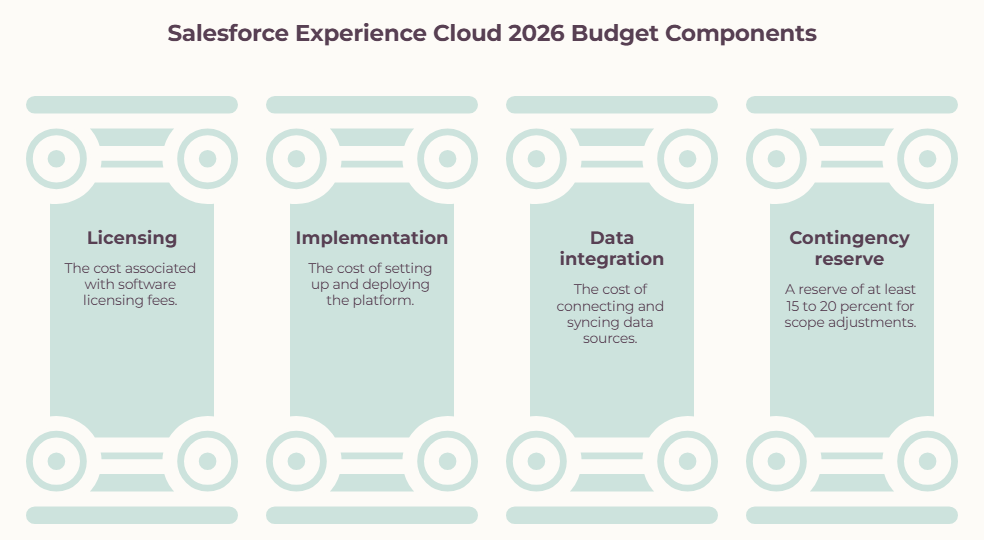
An implementable and realistic 2026 budget should include four separate lines.
- Licensing.
- Implementation.
- Data integration.
- A contingency reserve of at least 15 to 20 percent for the scope adjustments that surface during a pilot.
When you decide the budget for Salesforce Experience Cloud in 2026, you should treat the first year as the most expensive one. Implementation, training, and initial customisation are basically the front-loaded costs that mainly ease considerably from year two onwards.
Common Mistakes That Inflate Experience Cloud Budgets
Businesses that mostly under-budget by assuming login licences cover every use case, leaving permission and governance design until after launch and skipping a pilot phase. Each and every decision looks like a shortcut early on, but it turns out to be a costly correction later on.
The testing plan and overlooking a rollback is another frequent gap, especially at the point when a portal combines with several back-office systems. A short sandbox and a test real user journey remain the cheapest insurance against an expensive production fix.
Does Salesforce Experience Cloud Cost Increase as You Scale?
Growth of the business changes the pricing equation in different ways that are easy to miss during the initial planning. As member numbers go beyond the previous initial thresholds, businesses mostly need to move up a licence tier, add capacity for peak traffic during busy periods, and expand data storage.
Whether Salesforce Experience Cloud costs increase as businesses scale is a valid question for any growing organisation, and honestly, yes. A well-architected portal can easily scale membership faster than it scales cost.
Plan Your Salesforce Experience Cloud Investment with ProvidusCRM
ProvidusCRM’s certified Salesforce consultants help UK organisations scope, cost, and implement an Experience Cloud portal without the budget surprises. Our team has delivered portal implementations across financial services, nonprofit, and commerce sectors. Each is built around real usage patterns, not a generic licence template.
Explore Salesforce Implementation Services to discuss your Experience Cloud licensing model, scope, and realistic 2026 budget with a certified team, or you can contact us directly to discuss your objectives.
Conclusion
Salesforce Experience Cloud pricing is layered by configuration, design, integration, and built from licences and ongoing administration. Businesses that plan for the full picture in 2026, rather than only a licence figure, systematically deliver portals that are more predictable to run and also easier to justify to the finance teams.
Getting this right is less about negotiating a lower licence cost and much more about scoping accurately from the outset, building in constructive solutions for the inevitable surprises, and also choosing the correct licence type for the real usage patterns.
Frequently Asked Questions
Can an existing customer portal be migrated to Experience Cloud without losing search rankings?
Yes, with a planned URL redirect strategy and careful content migration, existing SEO equity can largely be preserved.
Does Experience Cloud pricing include mobile access for external users?
Experience Cloud portals are responsive by default, so mobile access is included without a separate licence fee.
Is Salesforce Experience Cloud available on a monthly contract?
No, Salesforce licensing is sold on an annual contract and typically with multi-year renewal terms.
How long does a typical Experience Cloud implementation take before go-live?
Straightforward portals typically launch in eight to twelve weeks, while complex, multi-integration builds can take several months.
Do external portal users need Salesforce training to use the site?
No, external users interact with a branded and simplified interface that requires no Salesforce knowledge at all.