Nonprofits hardly struggle because they do not have clear objectives, but mostly teams face manual reporting, scattered donor records, discounting fundraising tools, and also limited time to understand what their data reveals.
Salesforce can help charities to organise information, improve supporter communication, and also track programme outcomes, however, its value depends on how the platform is mainly configured around each organisation's requirements.
The Charity Digital Skills Report 2026 has found that 81% of charities had achieved digital progress over the previous year, but only 29% had a digital strategy, these are the findings that highlight why technology requires a clear purpose.
How Nonprofits Are Using Salesforce to Solve Everyday Data Problems?
Charities rarely lack purpose, but many teams face disconnected fundraising tools, manual reporting, fragmented donor records and limited time to understand what their data reveals. Nonprofits using Salesforce can improve supporter communication, centralise information and track programme outcomes. Salesforce nonprofit consulting helps organisations configure the platform around their specific operational needs and fundraising goals.
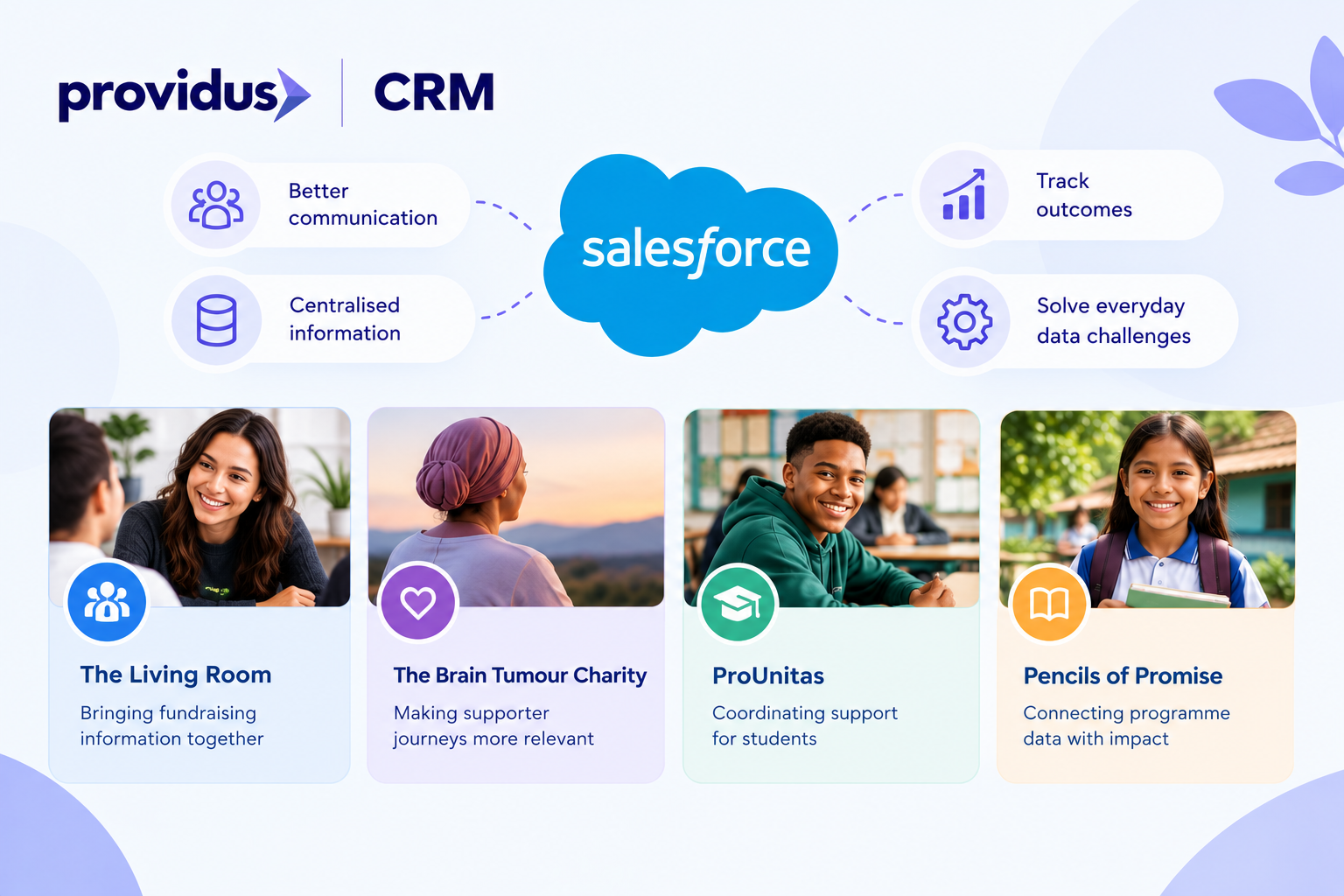
The value depends on how the platform is configured to meet each organisation’s requirements. The following four examples, The Living Room, The Brain Tumour Charity, ProUnitas and Pencils of Promise, demonstrate how organisations have used Salesforce to identify and address specific operational challenge
The Living Room: Bringing Fundraising Information Together
The Living Room, a Hertfordshire charity that supports people affected by addiction, had fundraising and events information spread across emails, documents, spreadsheets, and shared drives, this fragmentation made reporting donations and managing Gift Aid more difficult.
As per the case study of PWC, the charity rebuilt its CRM around Salesforce in order to bring grants, fundraising, events, and operational information together. Moreover, the charity also enables staff outside fundraising to access Salesforce and also encourages wider collaboration.
Shared records can also reduce the time that is normally spent chasing updates, and with this, it help teams work with consistent information. For nonprofits utilizing Salesforce, the core lesson is to map donor journeys and also internal tasks before selecting fields, objects, automations and reports. This part ensures the system reflects actual working practices.
The Brain Tumour Charity: Making Supporter Journeys More Relevant
The Brain Tumour Charity's objective was to improve how it is understood and communicated with supporters. Messages based only on event participants can miss opportunities to explain alternative ways to contribute and share updates related to research.
As per Salesforce’s customer story, the charity used Sales Cloud with Marketing Cloud to support personalised supporter journeys, and its campaign has reported a twofold uplift in donations per donor, a 1.7-fold increase in donation amount, and £4,000 in incremental revenue over 12 days, these are the campaign-specific results.
For nonprofits using Salesforce, marketing automation and CRM data should always be planned together. Maintain accurate records, define the information that is required, and test whether communications reflect the consent and interests of supporters.
ProUnitas: Coordinating Support for Students
ProUnitas always works with schools to connect students with services when barriers, for instance, food insecurity, affect their progress. Previously, social workers and counsellors relied on paper-based referrals and manual case management, but in a Salesforce customer story, the organisation explains PurpleSENSE, a Salesforce-powered platform that is designed to coordinate student support and referrals.
Salesforce has reported that ProUnitas has saved more than 30 staff hours each week through its 13 - person operation, this also illustrates the potential value of reducing repetitive administration, although the outcome depends on the adoption and workflow of every organisation.
Pencils of Promise: Connecting Programme Data with Impact
Pencils of Promise runs educational programmes that include scholarships, teacher support, sanitation and hygiene work. With these activities spread across several countries and teams, it requires a reliable way to bring its information together.
What Can Nonprofits Learn from These Salesforce Examples?
Lessons learned always help us to prevent hurdles. These four lessons mentioned below will help you understand the process completely.
Start With A Specific Problem:
Identify delayed decisions, duplicated information, and repetitive administration before choosing technology. Features should also solve defined requirements rather than add unnecessary complexity.
Design The Data Model Before Automating:
Agree on required fields, record ownership, relationships, and data quality rules Automation that is built on inconsistent information can circulate errors rather than preventing them.
Make Reporting Useful:
Dashboards should answer practical questions related to campaign performance, programme outcomes and referrals. Every measure should always support a genuine decision.
Plan For Adoption And Governance:
Provide clear responsibilities, suitable training and appropriate access permissions. Along with this, review user feedback and data quality after the launch to identify issues early.
Is Salesforce Suitable for Every Nonprofit?
Not automatically, because suitability depends on the processes, size, technical capacity, budget, and reporting requirements of the organisation. A small charity with straightforward contact records might need less customisation as compared to a multi-service organisation that definitely requires complex integration and tailored Salesforce implementation services.
The Charity Digital Skills Report 2026 has found that 63% of charities had identified squeezed finances as their biggest hurdles to digital progress, and this reinforces the importance of evaluating costs before implementation. It includes migration, integration, licensing, configuration, training, and ongoing support in the business case.
Moreover, a phased rollout can help charities prioritise important functionality before introducing more complex features.
Build a Salesforce Approach Around Your Mission
These are examples that show how the technology can connect supporter engagement, fundraising, and programme delivery. Successful implementation needs reliable data, clear processes, measurable objectives, and appropriate security.
So, if your charity is reviewing its planning improvements or CRM, you can contact ProvidusCRM to discuss your implementation priorities and requirements. Furthermore, a considered plan can help your team a lot in choosing a proportionate solution and to avoid unnecessary customisation.
Conclusion
Nonprofits using Salesforce can explain how shared information can improve coordination across service, fundraising, and programme reporting. The key is to start with the mission of the organisation and then configure technology related to its requirements.
Reliable data, clear ownership, and continuous review remain important after launch, with realistic requirements and appropriate implementation planning. Charities can make informed technology decisions.
Frequently Asked Questions
1. Can a small charity use Salesforce?
Yes, if its requirements, budget, and capacity to manage the system justify the investment.
2. Can Salesforce connect with an existing donation platform?
Mostly, through a compatible connector, API, or integration application.
3. How should a nonprofit measure Salesforce success?
Track baseline measures such as reporting time, data completeness, and supporter engagement.
4. Does a charity need a Salesforce specialist?
Complex migrations, integrations, and security requirements may benefit from specialist support.
5. What should a nonprofit prepare before implementation?
Document its processes, data sources, user roles, reporting needs, and privacy requirements.