

Nonprofits operate in environments where every resource matters. No matter how sophisticated your CRM or AI-driven analytics platform is, it becomes useless if your team is afraid to adopt it. According to the Stanford Social Innovation Review, successful digital transformation depends as much on people and organizational culture as it does on technology.
To bridge this gap, organizations must move beyond the purchase and focus on nonprofit technology training that actually sticks. You can't simply bring in a consultant to show a few slides, only for everyone to return to their spreadsheets later. This old way no longer works. Resources from the CDC also emphasize that continuous, role-specific training is more effective than one-time learning sessions.
For maximum technology adoption, you should ensure that the provided training is continuous and contextual. Otherwise, technology feels like a burden rather than a bridge to your mission, and impact plateaus. Organizations such as the National Council of Nonprofits and Candid offer valuable guidance on strengthening nonprofit capacity, while research from the Pew Research Center and best practices from NIST reinforce the importance of building digital skills and adopting technology effectively.
What Effective Nonprofit Technology Training Looks Like?
A solid number of charities invest in technology in the hope of doing more good, yet they see little impact. Most of the time, the reason is that their team resists adapting. And when this happens, even the best platforms become underutilized, misunderstood, or abandoned altogether.
The best practice here is to equip your teams with the confidence, clarity, and practical skills they need. Instead of overwhelming staff with theory or disconnected features, it focuses on real impact. See what an effective nonprofit technology training looks like in practice:
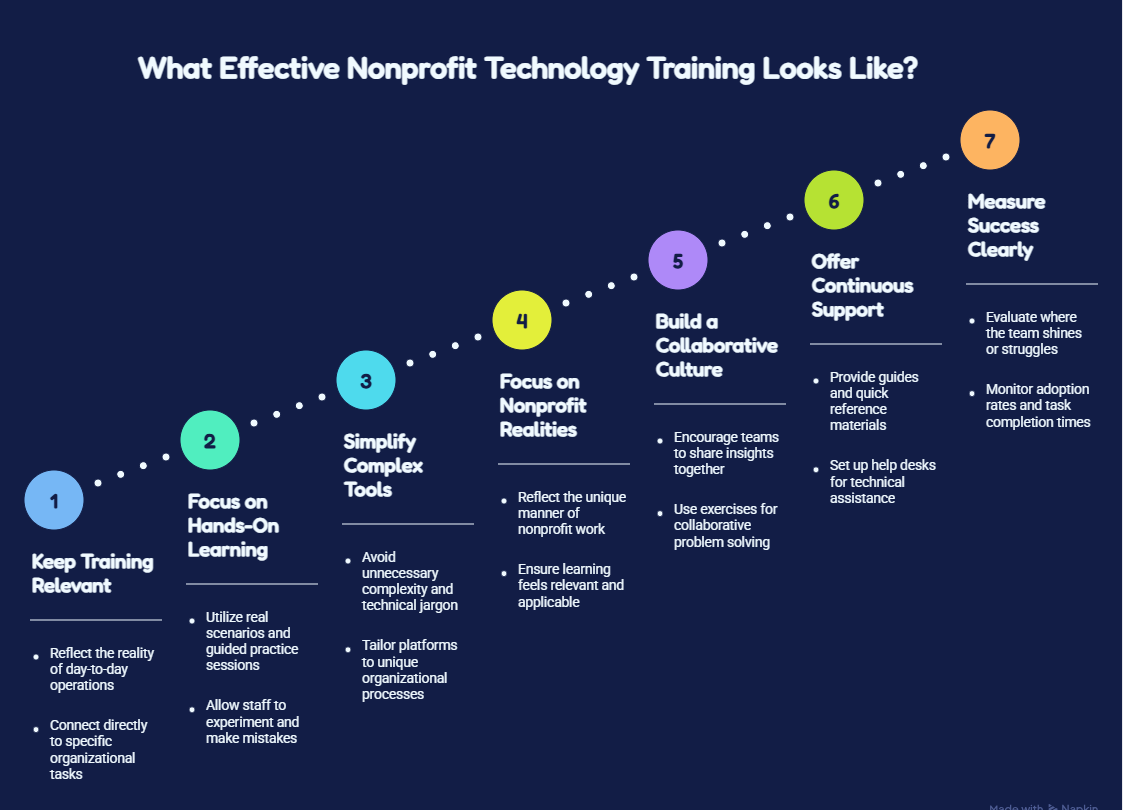
1. Keep Training Relevant
Training becomes meaningful when it reflects the reality of your day-to-day operations. Your staff will love knowing how such a tool helps them send better donor emails or generate reports faster over abstract lessons. When training connects directly to these tasks, it feels immediately useful, especially when supported by experienced Salesforce consulting services that align technology with your nonprofit's workflows.
2. Focus on Hands-On Learning
People learn best by doing. Hands-on exercises, real scenarios, and guided practice sessions help teams gain confidence. They can experiment, make mistakes, and learn in a safe environment.
3. Simplify Complex Tools
Some of your staff members may be highly tech-savvy, while others feel less confident. Ensure the training avoids unnecessary complexity. Break down concepts into clear, manageable steps and use plain language instead of technical jargon. This is crucial when managing complex systems like Salesforce Nonprofit Cloud, where Salesforce customization services can tailor the platform to your organization's unique processes and make adoption easier.
4. Focus on Nonprofit Realities
Generic training really doesn't work here. Nonprofits work in a totally different manner than profit organizations do. Your training should reflect these realities. Make use of charity-related examples, scenarios, and goals. Such a minor tweak can make learning feel relevant and directly applicable.
5. Build a Collaborative Culture
Learning does not have to happen in isolation. Some of the most effective training environments encourage teams to share insights, ask questions, and learn from each other.
Group sessions, team exercises, and collaborative problem-solving help reinforce knowledge.
6. Offer Continuous Support
Staff often need support as they begin to apply new tools in real-world situations. You can provide them with follow-up resources such as guides, quick-reference materials, and access to support channels. If possible, set up a help desk for technical assistance. Many organizations also benefit from Salesforce development consulting to continuously improve workflows and address evolving operational needs.
7. Measure Success Clearly
In the end, it is highly recommended to measure the effectiveness of your training sessions. See where your team shines and where they struggle, then tweak your sessions based on that feedback. Salesforce Nonprofit Cloud can help track metrics such as tool adoption rates, task completion time, error reduction, and improved reporting accuracy, giving you clearer insights into training outcomes.
How to Navigate Training Constraints in the Nonprofit Sector
It’s a classic nonprofit paradox: you’re so busy saving the world that you don't have time to learn how to save it more efficiently. When you're operating on a shoestring budget and every staff member is wearing five different hats, sparing a few hours for professional development feels like a lot. There are a few common training challenges you should know about. As a result, you end up building a culture of learning without breaking the bank or the schedule.
Embrace Micro-learning
The traditional model of day-long seminars is often incompatible with the frantic pace of nonprofit work. Instead, organizations should pivot to microlearning, which involves breaking down complex subjects into 5- to 15-minute segments. This approach respects their time while ensuring that professional growth stays on the weekly calendar.
Peer-To-Peer Knowledge Exchange
Some of the best experts in the field are likely already in your office or on your Slack channel. Encourage peer-to-peer learning, which leverages the internal expertise of your team. You can allow a social media-savvy intern to teach a veteran program manager about engagement trends, or a grant writer to share storytelling tips with the fundraising team.
Role-Based Modular Training
A volunteer coordinator doesn't necessarily need to sit through a deep dive into GAAP accounting standards, and vice versa. To increase efficiency, training should be delivered in modules tailored specifically to an individual’s function within the organization.
Active Leadership Support
Ask your executive directors and board members to be part of the learning or share insights related to professional development. This kind of participation will send a positive message to your team.
Leverage Open-Source Resources
The small budget is not the right excuse for a lack of training. There is a massive ecosystem of high-quality, free resources designed primarily for nonprofits. It ranges from webinars by organizations like TechSoup to certifications. Shared an internal library of these free resources with your team for world-class education.
Introduce Gamification
Despite sometimes being boring, training can be made engaging through light gamification. You can introduce badges, progress trackers, or small rewards for completing certain learning milestones. Even a single appreciation can significantly boost user interest and promote forward-thinking.
Wrapping Up
Building a tech-forward nonprofit doesn't happen by accident, and it certainly doesn't happen overnight. The only way to achieve excellence is to empower your team through consistent, high-quality nonprofit technology training.
With successful technology adoption, you will enjoy faster outreach, deeper donor connections, and more transparent reporting. Ultimately, the impact of effective training is felt most by the communities you serve.
However, navigating the complexities of digital transformation can be overwhelming for even the most dedicated teams. To bridge the gap between where you are and where you need to be, lean on the support of specialists who offer Salesforce nonprofit cloud consulting and implementation.
Ready to transform your nonprofit with Salesforce? ProvidusCRM helps nonprofits implement, customize, and optimize Salesforce solutions while empowering teams through practical technology adoption strategies. Contact Us today to discover how we can help your organization improve efficiency, strengthen donor relationships, and maximize mission impact.
Remember, tools are only as powerful as the hands that hold them. Equip your team, strengthen your mission, and watch the ripple effect take hold.
Frequently Asked Questions (FAQs)
1. Why is nonprofit technology training important?
Nonprofit technology training helps staff confidently use digital tools, CRM platforms, and automation software to improve fundraising, donor management, reporting, and program delivery. Well-trained teams achieve higher technology adoption rates and maximize the value of their technology investments.
2. What makes nonprofit technology training effective?
Effective nonprofit technology training is continuous, role-based, and hands-on. It focuses on real-world nonprofit scenarios, encourages collaboration, provides ongoing support, and measures adoption through clear performance metrics rather than one-time training sessions.
3. How can Salesforce improve nonprofit operations?
Salesforce Nonprofit Cloud helps organizations centralize donor data, automate fundraising workflows, manage volunteers, generate reports, and improve stakeholder engagement. With the right implementation and training, nonprofits can increase efficiency and make more informed decisions.
4. How do Salesforce consulting services support nonprofit technology adoption?
Experienced Salesforce consulting services help nonprofits implement, customize, and optimize Salesforce based on their operational needs. Combined with effective staff training, these services improve user adoption, streamline workflows, and increase long-term return on investment.
5. What are the biggest challenges nonprofits face when adopting new technology?
Common challenges include limited budgets, lack of staff training, resistance to change, time constraints, and insufficient ongoing support. Addressing these barriers through continuous learning and leadership engagement significantly improves technology adoption.
6. How often should nonprofit staff receive technology training?
Technology training should be an ongoing process rather than a one-time event. Regular refresher sessions, micro-learning modules, and updates whenever new features or systems are introduced help staff stay confident and productive.