
For a nonprofit, data is hardly limited to email addresses and donor names. A constituent might be a volunteer, a donor, an event attendee, or even a programme participant. Each of these interactions becomes more important when it is connected correctly.
This develops a technical challenge: organisations need reliable ways to connect, store, protect, and to retrieve information. Effective data work is therefore less about collecting more records and more related to designing trustworthy relationships between them.
The sector overview of the Charity Commission has reported that 171,494 main registered charities in Wales and England and around 6.5 million volunteers have shown the scale of constituent information that organisations may coordinate.
Why Does Nonprofit Database Management Matter?
A nonprofit database should answer more than “who is this person”? It should always show how someone has interacted with the organisation, which programmes or activities they are connected with, and what they have supported.
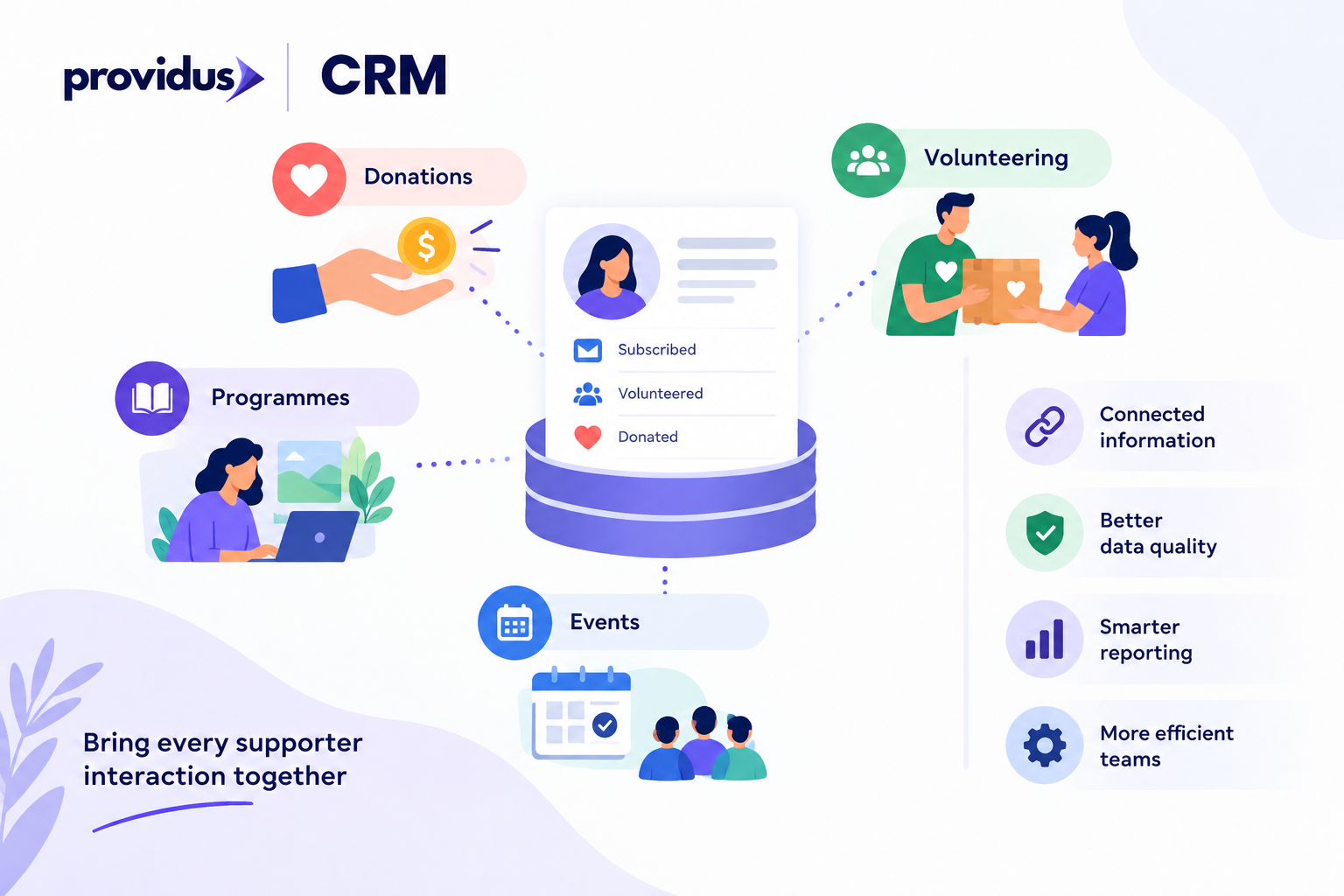
For instance, a supporter who first subscribes to a newsletter, later volunteers for an event, and then eventually makes a donation. If every interaction sits in a different spreadsheet, the organisation might treat one person as three unrelated records.
This matters when teams require reliable reporting. Fundraising might need donors by campaign, while volunteer teams need attendance and availability. With Salesforce Integration, organisations can connect relevant systems and bring important supporter interactions together, making it easier to maintain a consistent view of relationships and activities. Let’s understand the best practices.
1. Start With a Clear Data Model
Strong database implementations start with structure and not software. Before configuring any platform, you should define the entities, the needs of the organisation, and their relationships.
Typical entities include households, donations, constituents, events, campaigns, volunteers, grants, programmes and communications. This should be documented even before the system reaches production. Furthermore, you should decide which records stand alone and which should connect to an already existing constituent rather than creating duplicates.
A donation should not become a second constituent record only because it arrives through another fundraising channel, but it should relate to the correct person or even organisation while retaining data, campaign, amount, and designation.
2. Establish Data Standards Before Importing
A database produces dependable information only when records follow consistent rules. Define standards for addresses, telephone numbers, consent status, names, email addresses, campaign value, and other recurring fields.
Duplicate management is also important during migration. If “The Community Charity”, “Community Charity Ltd” and “Community Charity” represent the same organisation, communication and reporting can become fragmented unless records are matched and reviewed.
The same principle applies to picklists, different labels can distort reporting and segmentation.
3. Treat Data Quality as an Ongoing Process
Cleaning data once is not related to the same as maintaining data quality. New records enter the system through imports, web forms, event registration, fundraising platforms, and manual entry.
A governance process should explain mandatory fields, data ownership, and duplicate review and correction procedures, along with this, validation rules can prevent errors at entry, while scheduled reviews identify the issues that can occur later.
Furthermore, if automation depends on consent status, an incorrect value can trigger unsuitable communication, and this is the reason why data quality is basically a part of operational control.
4. Apply Data Protection and Access Controls
Nonprofits mostly hold personal information requiring careful handling, and this includes volunteer information, contact details, donation histories, and also, most importantly, sensitive information.
The office of Information Commissioner has identified seven UK GDPR principles and it includes purpose limitation, lawfulness, data minimisation, storage limitation, accuracy, security and accountability, along with this, these should influence how personal data is gathered and used.
Moreover, strong nonprofit database management also needs clear ownership of sensitive fields. For instance, a fundraising user may require donation information, while a volunteer coordinator might primarily require shifts, attendance, and availability.
5. Connect Fundraising, Programmes and Volunteers
The next step is moving ahead of isolated datasets. A modern nonprofit database should connect fundraising with volunteering, programmes, and engagement where processes need it. With the help of ProvidusCRM, Nonprofit Cloud gives organisations a set of tools spanning fundraising, impact tracking, programme delivery, grant management, and volunteer coordination.
On the volunteer side, each of the record can be tied to the activities a person participates in, the roles they hold, the locations they work at, their shifts, and whether they turned up. The volunteer management feature also helps with planning capacity and keeping a history related to the involvement of every person. The main element is to link these records together so that teams can easily see how someone engages with the organisation as a whole instead of looking at isolated data points.
6. Build a Single Source of Truth
Establishing a Single Source of Truth (SSOT) does not mean replacing every niche application. Non-profits often retain specialized platforms for payment processing, email marketing, and accounting. The key is defining clear data ownership (System of Record) across integrated systems so changes in constituent profile data sync predictably without creating conflicting records.
Salesforce might hold constituent relationships while a payment provider processes transactions. Moreover, integration can pass mandatory information without making both platforms responsible for the same record.
In this way, conflicting information gets reduced, and if a supporter changes their email address, the organisation needs to know where that change has originated and which systems receive the update.
7. Design Reporting Around Decisions
A database is impactful when information supports decisions. Before building dashboards, identify the questions that operational teams require to ask. Moreover, fundraising might need donor retention and campaign performance, volunteer teams need attendance and capacity, and programme teams may need participation and outcomes, and these requirements should impact database fields.
Good reporting always depends on consistent definitions. If teams use different time periods for an active donor, apparently accurate reports can disagree.
8. Use Automation Carefully
Automation can easily reduce repetitive administration, but it should follow a defined process. Starts with identifying the trigger, action, exception, conditions, and expected outcome.
On the other hand, a donation could update giving history, while a volunteer application could initiate a review, and, along with this, test workflows with normal and also with exceptional records before release.
Mainly, automation amplifies data quality, a manual error might affect one record. Testing and monitoring should therefore be part of this database lifecycle.
Which Tools Should a Nonprofit Consider?
The correct tool depends on the size of an organization, existing systems, and processes. Platform selection depends on scale, complexity, and integration needs. While entry-level platforms like Beacon or Bloomerang suit smaller teams with single-use requirements, growing organizations with multi-departmental operations (fundraising, programs, volunteering, and grant management) benefit from extensible enterprise architectures like Salesforce Nonprofit Cloud.
Moreover, for strong nonprofit database management, the tool should support a clear data model, along with programmes and a fundraising database. So before choosing, check integration options, UK GDPR support, and also the cost of scaling and reporting flexibility. A tool that cannot integrate with email, payment, or accounting systems may create new data silos later.
When Should a Nonprofit Seek Specialist Support?
Complexity usually appears when a nonprofit moves from spreadsheets or even from legacy systems, consolidates databases, introduces automation, and integrates applications.
Transitioning from legacy databases or fragmented spreadsheets to an enterprise architecture requires rigorous data mapping, schema normalization, and change management.
ProvidusCRM’s certified solution architects help non-profits design compliant, scalable Salesforce environments, connecting constituent records directly to fundraising, volunteering, and program delivery. Explore our Salesforce nonprofit consulting services to optimize your database architecture.
Conclusion
Effective nonprofit database management is related to creating dependable information that people can use. The objective is not to collect every possible field, but it is to keep important records secure, connected, accurate, and useful.
Start with the data model, remove duplicates, establish standards, define ownership, apply access control, and connect the systems that need to exchange information, and after all this, build reporting automation around clearly defined processes.
Frequently Asked Questions
1. Can a nonprofit database store volunteer and donor records together?
Yes, for larger nonprofit teams, a practical nonprofit database management model separates activities while linking them to appropriate constituent records.
2. How often should nonprofit databases be cleaned?
Data quality should be monitored continuously, with duplicate checks and governance reviews scheduled according to organisational needs.
3. Should a nonprofit keep historical records after changing CRM systems?
Relevant historical information should be retained according to legal, regulatory, and organisational retention requirements.
4. What is the difference between a nonprofit database and a CRM?
A database primarily stores structured information, while a CRM adds relationship management, workflows, communication, and reporting capabilities.
5. Can Salesforce integrate with a nonprofit’s existing systems?
Yes, Salesforce can integrate with existing systems, but the architecture depends on data ownership, integration methods, security requirements, and business processes.