
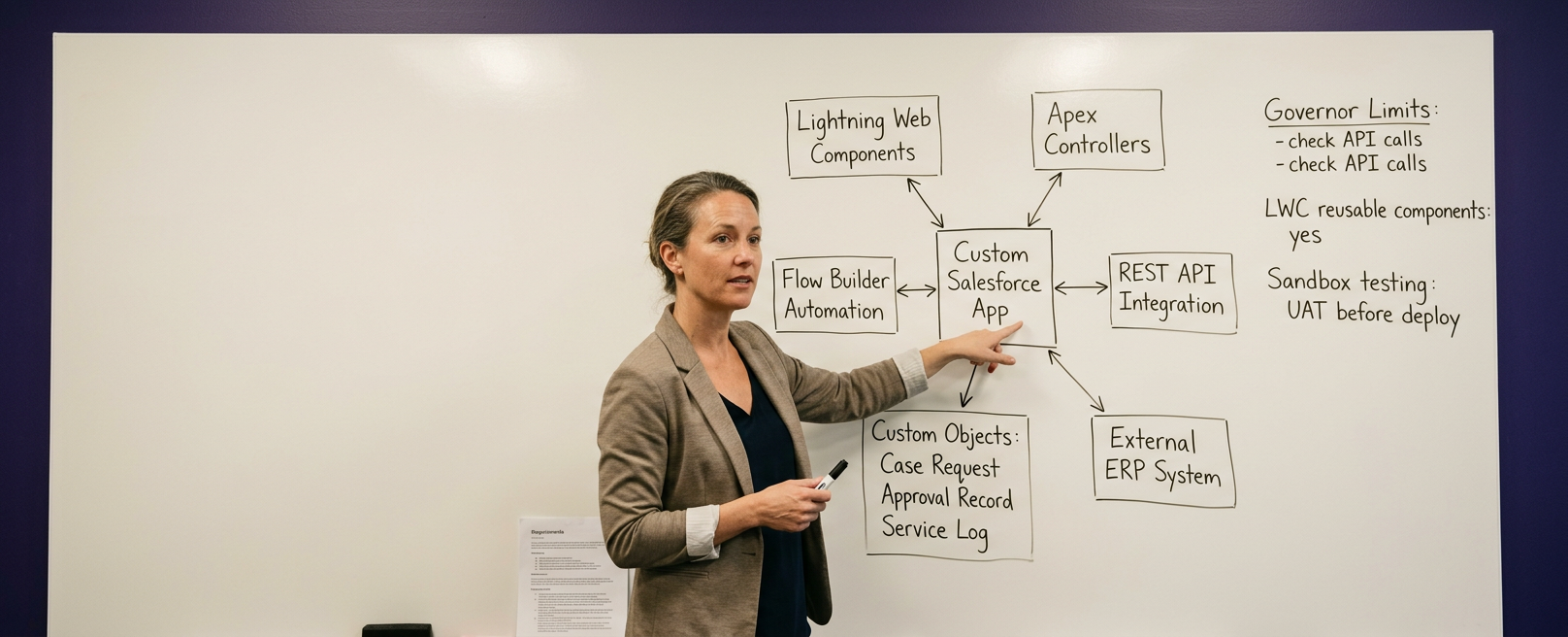
Modern organisations rarely operate with identical business processes. Whether managing customer onboarding, automating service requests, handling regulatory approvals, or integrating multiple business systems, organisations eventually reach a point where standard CRM functionality is no longer enough. This is why understanding how to build custom Salesforce apps has become an important capability for businesses looking to maximise their CRM investment. Salesforce’s official guidance on custom app development provides a useful reference for organisations exploring ways to extend their CRM capabilities.
The growing demand for enterprise applications reflects this turn. According to Gartner, the worldwide low-code development technologies market is projected to reach $58.2 billion by 2029, driven by AI-assisted development, enterprise digital transformation, and operational efficiency initiatives. This eventually demonstrates that organisations are increasingly investing in platforms that allow them to develop tailored business applications faster and, with this, maintain governance and scalability.
Why Do Businesses Invest in Custom Salesforce Apps?
Every organisation has its own compliance obligations, operational processes, approval chains, and customer engagement models. Attempting to force these unique requirements into standard CRM functionality often leads to duplicate data, manual workarounds, inconsistent reporting, and reduced user adoption.
This is where custom Salesforce apps deliver measurable value. With the support of an experienced Salesforce consultant, organisations can build applications around their existing processes rather than changing the business to fit the software. These applications can automate workflows, manage industry-specific data, create role-specific interfaces, and integrate external systems without compromising security or scalability.
Understanding Salesforce App Development Process
Multiple business leaders assume application development starts with writing code, but in reality, coding represents only one phase of a much larger development lifecycle. Successful Salesforce app development starts by understanding business challenges, not the technical requirements.
Development teams collaborate with stakeholders, and the purpose is to identify process inefficiencies, security considerations, reporting requirements, regulatory obligations, and future scalability. Let’s understand it step by step.
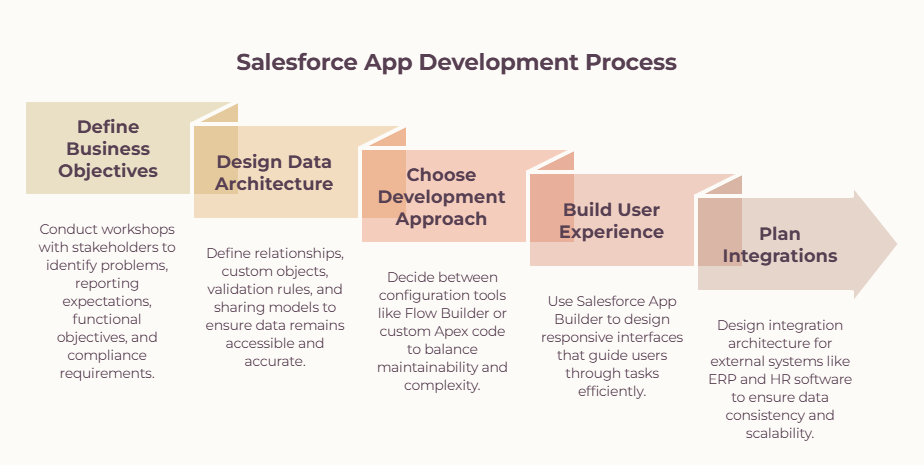
Step 1: Clear Business Objectives Before Development Begins
Every successful and result-oriented application starts with clearly defined business objectives. Development teams should conduct workshops with department managers, process owners, Salesforce administrators, and technical architects to understand clearly what problem the application is expected to solve.
Without this discovery phase, projects mostly deliver technically impressive solutions that eventually fail to address operational challenges. Requirements should include reporting expectations, functional objectives, compliance requirements, user permissions, integration needs, and anticipated future enhancements.
Step 2: Design a Scalable Data Architecture
One of the most important phases when organisations build Salesforce apps is designing an effective data model. A well-structured data architecture determines and explains how information is related, stored, secured, and reported throughout the platform.
Developers define relationships, custom objects, validation rules, sharing models, record ownership, and indexing strategies to ensure data remains accessible and accurate as the application grows. Poor architectural decisions at this stage mostly lead to duplicate records, complex reporting, performance issues, and expensive redevelopment later in the project.
Step 3: Choose the Right Development Approach
Modern Salesforce development is no longer limited to being code-driven. Organisations must decide whether a business requirement can be delivered using configuration tools, custom programming, or a combination of both.
A balanced Salesforce custom app development strategy prioritises declarative tools (like Flow Builder) wherever practical while reserving Apex custom code for complex business logic. This approach improves maintainability, reduces ongoing support costs, and simplifies future platform upgrades.
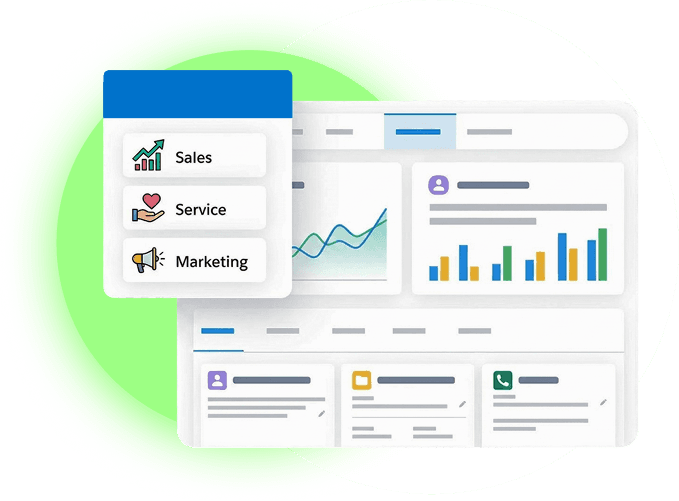
Step 4: Build an Intuitive User Experience with Salesforce App Builder
Even technically advanced applications fail only if users find them difficult to navigate. Using Salesforce App Builder, organisations can design responsive interfaces that will present relevant information based on user responsibilities, roles, and business processes. Rather than overwhelming users with irrelevant and unnecessary options, well-designed applications guide them through tasks efficiently while reducing training requirements. Application usability directly influences data quality, user adoption, and overall return on investment. For this reason, interface design should be treated as a main architectural consideration rather than a final-stage enhancement.
Step 5: Plan Integrations Before Development Starts
Enterprise applications rarely operate in isolation, but they frequently exchange information with finance platforms, ERP systems, HR software, document management systems, marketing automation platforms, and external REST/SOAP APIs.
Without careful integration planning, organisations may experience synchronisation failures, duplicate records, inconsistent reporting, or security vulnerabilities. Integration architecture must be designed alongside the application rather than being introduced after development has begun. A well-planned integration strategy also impacts and improves long-term scalability by allowing additional systems to be connected without requiring significant architectural redesign.
Why Does Architecture Determine Long-Term Success?
The most successful custom applications are not only those with the largest feature sets, but also the applications built upon strong architectural foundations that eventually support ongoing innovation, future growth, and changing business requirements. According to the 2025 Stack Overflow Developer Survey, which gathered responses from more than 49,000 developers across 177 countries, software teams continue to prioritise AI-assisted tooling, modern development practices, and scalable engineering approaches.
This highlights the growing importance of building applications that remain maintainable as business requirements and technologies continue to evolve. A well-architected application simplifies maintenance, improves performance, supports future integrations, and, with this, it also enables organisations to adopt emerging technologies without even requiring major redevelopment.
Guide for Salesforce App Development: Build for Scalability, Not Just Functionality
A successful Salesforce app development guide should focus on creating applications that remain maintainable as business requirements continue to evolve. Enterprise applications mostly integrate with multiple business systems, process large volumes of transactional data every day, and support thousands of users.
Instead of developing features in isolation, organisations must adopt a modular architecture where automation, components, and integrations can be updated independently. This will eventually reduce deployment risks and will also make future enhancements significantly easier to implement.
Before deployment, development teams should complete user acceptance testing (UAT), functional testing, performance testing, security validation, and regression testing. Catching data and logic defects inside sandbox environments before production release minimises operational disruption and protects business continuity.
Strategy Of Custom Salesforce Application Development
Successful custom Salesforce application development begins with governance rather than development. A governance framework defines naming conventions, coding standards, deployment processes, documentation requirements, and change management procedures. Without these standards, organisations mostly experience inconsistent development practices that eventually increase technical debt over time.
Development teams should establish clear version control using platforms like Git alongside Salesforce DevOps Center, implement automated testing where possible, and document business logic for future administrators. Well-documented applications are easier to audit, maintain, and extend as organisational requirements change.
How Does Salesforce Lightning App Development Build Responsive Enterprise Applications?
Today's users expect enterprise applications to provide the same usability and responsiveness as consumer applications. This is the reason why Salesforce Lightning app development focuses on creating responsive interfaces that improve productivity while maintaining accessibility across desktop and mobile devices.
Lightning Web Components (LWCs) enable developers to create reusable interface components that improve performance, and they also reduce duplication throughout the application. Rather than rebuilding similar functionality repeatedly, organisations can develop component libraries that can support multiple business processes while maintaining a consistent user experience.
Best Practices of Salesforce App Development
Developing enterprise applications needs more than technical knowledge. Following recognised engineering practices significantly improves security, application quality, and long-term maintainability.
The most effective Salesforce app development practices include defining business requirements before development, prioritising declarative functionality where appropriate, designing scalable data models, implementing role-based security, documenting every customisation, and establishing a structured release management process.
Developers should also avoid hard-coded values, monitor API consumption, regularly review platform performance, and conduct security assessments before every production deployment. These practices reduce operational risk while supporting future platform upgrades.
Common Mistakes to Avoid During Application Development
Many organisations assume successful application delivery primarily depends on development speed. In practice, long-term success depends on planning, architectural quality, and governance. Common mistakes include creating overly complex Flow routines, developing without clear requirements, failing to optimize data models, ignoring platform Governor Limits, neglecting Object and Field-Level Security (FLS), and introducing custom Apex code where standard configuration works.
Another frequent issue is insufficient documentation. Applications that lack architectural documentation become increasingly difficult to maintain, particularly when new administrators or development teams assume responsibility for future enhancements. Avoiding these mistakes improves scalability, simplifies upgrades, and reduces long-term operational costs.
Why Partner with ProvidusCRM?
Building enterprise Salesforce applications requires architectural planning, technical expertise, and a thorough understanding of business processes. At ProvidusCRM, our consultants help organisations develop, design, integrate, and optimise Salesforce applications that support long-term business growth.
From solution architecture and application design to integrations, automated testing, and post-deployment support, we focus on delivering applications that are secure, scalable, and aligned with your operational objectives. Whether you are modernising legacy systems, extending existing CRM capabilities, or even building an entirely new business application, our experienced Salesforce specialists provide practical guidance throughout every stage.
Conclusion
Building a successful Salesforce application is not simply about writing code, as it involves understanding business objectives, implementing secure integrations, designing scalable architectures, creating intuitive user experiences, and following disciplined development practices throughout the project lifecycle.
Organisations that invest time in governance, planning, and documentation are better positioned to develop applications that remain reliable as business requirements evolve. By combining technical expertise with a structured development strategy, businesses can maximise the value of their Salesforce investment while reducing implementation risks and future maintenance costs.
Frequently Asked Questions
1. What is the first step in building a custom Salesforce application?
The first step is understanding business requirements. Organisations should identify user needs, operational challenges, reporting requirements, integrations, and compliance obligations before beginning technical design.
2. When should businesses choose custom development instead of standard Salesforce features?
Custom development is appropriate when business processes cannot be efficiently supported using standard Salesforce functionality or declarative configuration tools.
3. What programming technologies are commonly used in Salesforce application development?
Developers typically use APIs, Apex, Lightning Web Components (LWC), Flow, SOQL, and platform automation tools depending on the application's requirements.
4. How long does it take to develop a custom Salesforce application?
Project duration depends on integrations, complexity, testing requirements, and business scope. Small applications may take several weeks, while enterprise implementations mostly require several months.
5. Why is application governance important?
Governance establishes documentation, coding standards, security policies, deployment procedures, and quality assurance practices that improve maintainability and also reduce long-term technical debt.