
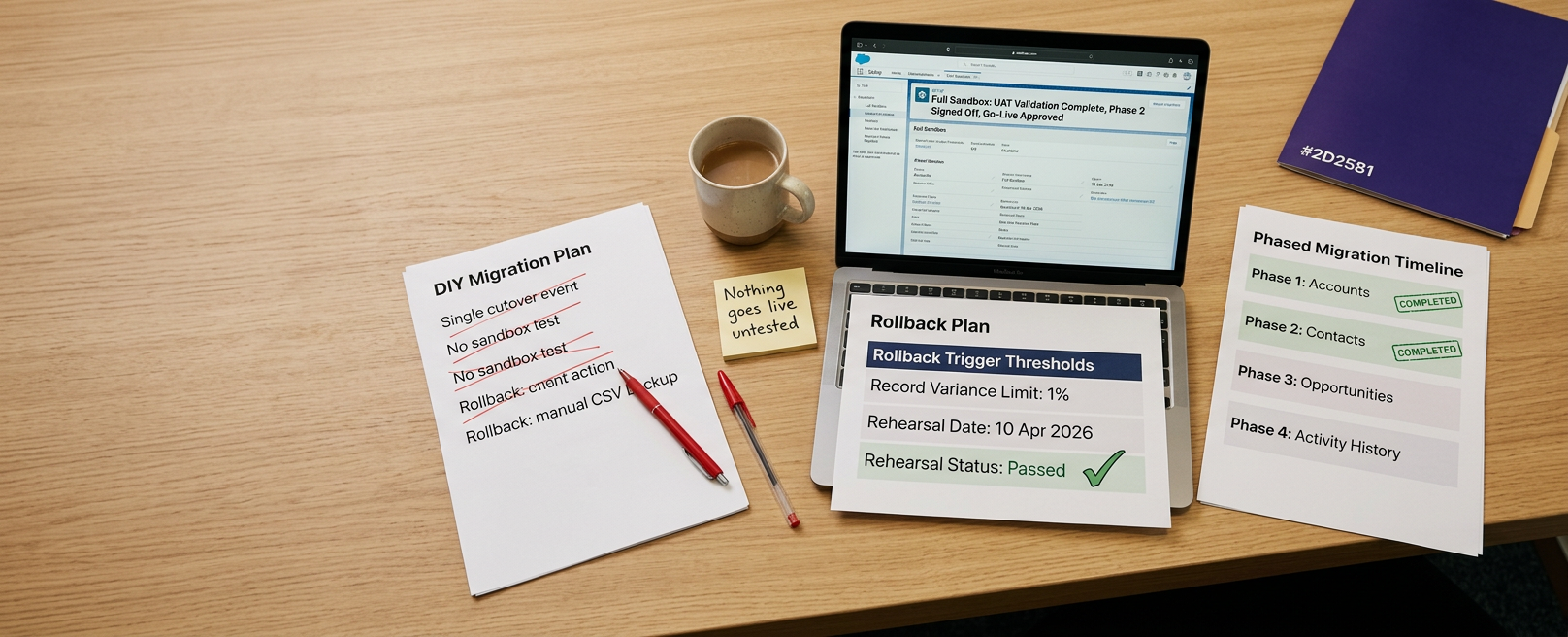
Most organisations only realize how risky a CRM migration is after critical workflows break in production. Workflows break, records go missing, and sales teams quietly slide back into spreadsheets within weeks of go-live.
The organisations that avoid this outcome rarely do it alone, but they bring in a Salesforce consultant for a platform migration engagement especially designed to catch problems before they reach production, not after.
This guide breaks down what a risk-free Salesforce migration looks like in practice, contrasting a costly cutover with a structured, secure, and effortless transition.
Why Platform Migrations Carry More Risk Than Teams Expect
The risk of migration is rarely related to the technology itself. Salesforce is a well-documented and mature platform, and the tooling to move data perfectly is widely available and reliable. The risk sits in everything around the technology.
Incomplete field mapping, unclear ownership, untested automation, and rollback plans that exist only on paper. Research from Syncmatters found that 55% of CRM migration projects fail to deliver on their original promises, and it is due to underestimated complexity and inadequate planning.
On the other hand, a separate study from Oneprofile puts the figure even higher for enterprise-scale projects and states that 83% of data migration initiatives exceed their timelines or fail outright, even among teams with dedicated staff and proper staging environments.
What makes these numbers striking, it is that most of the underlying causes are entirely preventable. Rushed testing windows, poor scoping, and unclear rollback ownership show up again and again across failed projects, regardless of company size or industry.
Numbers like these are precisely why a structured Salesforce consultant platform migration approach exists. It replaces guesswork with a repeatable and tested process built specifically around Salesforce's security rules, data model, and automation architecture.
What actually changes when a certified Salesforce consultant leads the migration instead of an internal team following a basic checklist? The answer eventually lies less in the tools used and, yes, more in the discipline applied before any data moves.
What Does a Salesforce Migration Consultant Actually Do Differently?
A Salesforce migration consultant manages platform-specific risks by auditing data hygiene, defining object load hierarchies, configuring sandbox dry runs, and establishing automated rollback triggers before moving production data. Unlike internal IT teams performing one-off transfers, consultants apply repeatable governance frameworks designed around Salesforce API limits and security architecture.
A Salesforce migration consultant not only moves data from one system into another, but their real value lies in everything that happens before a single record is transferred, for instance, scoping, sandbox testing, mapping, and stakeholder sign-off.
This distinction matters more than most teams realise. The analysis from Stackplan found that self-implementation failure rates are more than twice as high as implementations led by a qualified consultant, and it is because internal teams lack the pattern recognition that comes from the experience of repeated, cross-industry migration.
A certified consultant anticipates platform-specific failure modes—such as storage limit breaches, recursive automation triggers firing during data loads, and broken parent-child record relationships.
They also bring platform-specific governance knowledge that includes how Salesforce's sharing rules, validation rules, and API limits interact with large-scale data loads, but equally important is objectivity.
Additionally, an external consultant has no stake in defending decisions made years earlier on the old system, which makes it easier to flag outdated processes that should not simply be replicated inside the new Salesforce org.
A Practical Guide for Salesforce Platform Migration
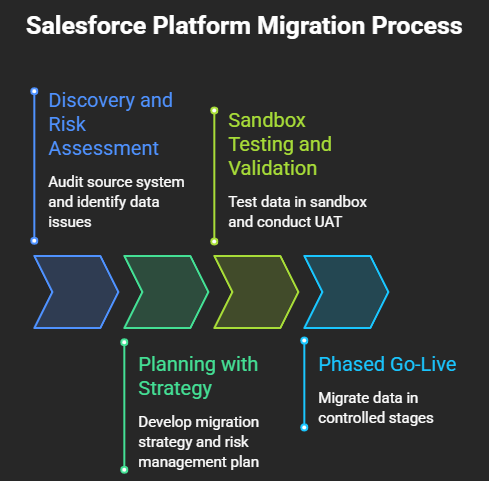
A dependable guide for Salesforce platform migration follows a consistent sequence, regardless of source system or company size. ProvidusCRM structures every engagement around four core layers.
1. Discovery and Risk Assessment for Salesforce Migration:
Before anything moves, the consultant audits the source system, identifies data quality issues, and also documents every field, object, and relationship that needs mapping.
This stage is where a proper risk assessment for Salesforce migration happens. Missing mandatory fields, duplicate records, and inconsistent picklist values are flagged early, when fixing them is still cheap.
2. Planning with Strategy:
The consultant builds a documented Salesforce consultant migration strategy that covers transformation rules, load order, quality gates, and a realistic timeline agreed with stakeholders before any technical work starts.
This is the point where Salesforce data migration risk management is formalised. Every identified risk is assigned an owner, a threshold that would trigger a pause or rollback, and a mitigation step.
3. Sandbox Testing and Validation:
Firstly, data is loaded into a sandbox and never straight into production. The consultant executes record-count reconciliations, temporarily disables validation rules and Apex triggers during Bulk API 2.0 loads, and conducts rigorous User Acceptance Testing (UAT) in a Full Sandbox.
4. Phased Go-Live:
Migration happens in controlled and structured stages, firstly accounts and contacts, then opportunities, then historical activity, with validation checkpoints between each phase rather than just one single high-risk cutover event.
Each of these four stages exists for a reason, and just skipping straight to a full data load without strategy, discovery, or sandbox testing is precisely the shortcut that eventually turns a routine project into one of the failure statistics.
What Are the Best Practices for Salesforce Migration?
| Migration Risk | Internal / DIY Migration (High Risk) | Consultant-Led Phased Migration (Controlled) |
|---|---|---|
| Data Architecture & Mapping | Direct 1:1 field dump; imports legacy tech debt and duplicate records | Automated deduplication, External ID mapping, structured object load sequencing |
| Execution Tooling & Limits | Standard Data Import Wizard; prone to Governor Limit timeouts | Bulk API 2.0 execution, ETL tooling, Apex trigger/validation bypass routines |
| Testing Environment | Developer Sandbox or direct-to-production cutover | Full/Partial Sandbox mirroring production permissions and validation rules |
| Rollback & Safety Nets | Manual backup CSV files; undocumented restore path | Automated metadata backups, Sandbox dry runs, rehearsed rollback triggers |
| User Adoption & Change Mgmt | Single cutover day; minimal post-launch support ($47\%$ drop-off) | Phased rollout, UAT sign-off gates, structured post-launch Hypercare |
Beyond the four-stage process, there are certain habits that separate smooth migrations from painful ones. ProvidusCRM importantly applies five of them on every engagement. Clean data before migration, not after; duplicate and incomplete records degrade Salesforce automation and reporting from day one. Map fields before writing any transformation code, since it actually prevents mandatory fields from being left blank or even mismatched during load.
Test in a sandbox that mirrors production, which surfaces permission issues and automation before they reach real users. Migrate in controlled phases using External IDs for upserts, maintaining automated metadata backups and a fully rehearsed rollback procedure to minimize consequences. This turns a potential crisis into a controlled, reversible step.
So now, asking what are the best practices for Salesforce migration early in a project, rather than after problems appear? This is the strategy that consistently separates organisations that stay on budget from those that don't focus on this aspect.
Process of Building a Genuine Rollback Plan for Salesforce Migration
A Salesforce migration rollback plan is an automated, pre-tested procedure that specifies exact thresholds, for example, data discrepancy rates >1%, broken security permissions, unmasked PII, etc. That triggers an immediate deployment pause and data restoration.
Every migration plan should assume something might go wrong, because sometimes it does go wrong. A written but untested rollback plan for Salesforce migration is not a real safety net, but it is simply an assumption that has not yet been challenged.
A proper rollback plan defines, in advance, the exact triggers that pause a migration. Record count mismatches beyond an agreed threshold, broken automation discovered in the testing procedure, or unmasked sensitive data found in staging.
Additionally, user adoption is also a part of this risk picture. Research from BeyondCRM found that a lack of structured post-launch support contributes to a 47% adoption failure rate; that means technical success alone does not guarantee a successful migration.
This is the reason why an experienced Salesforce consultant or platform migration partner rehearses the rollback process before go-live, and it also helps identify if there are any loopholes.
What Can You Expect From A Partner In Migration?
Reliable services for Salesforce migration should cover far more than the data transfer. ProvidusCRM's engagements include field mapping, discovery and risk assessment, transformation design, phased execution, sandbox validation, and post-go-live monitoring.
As a certified Salesforce partner, ProvidusCRM enforces strict platform governance, including GDPR-aligned anonymization during sandbox seeding, Salesforce Shield encryption protocols, and systematic Bulk API error handling.
The goal throughout is consistent: a risk-free Salesforce migration is not a marketing phrase but the outcome of tested rollback planning, disciplined process, and a consultant who has managed this exact type of transition before.
Conclusion
A Salesforce migration does not need to be a leap of faith. With the right Salesforce consultant platform migration approach, phased execution, structured risk assessment, and a rehearsed rollback plan, guesswork is replaced with a controlled and predictable process.
The statistics are clear: most CRM migrations that fail do so from preventable planning gaps, not from Salesforce itself. Partnering with an experienced consultant closes exactly those gaps. If your organisation is planning a platform move, ProvidusCRM's certified consultants can walk you through a tailored migration strategy built around your specific system, data, and timeline. Get in touch and let us handle your work.
Frequently Asked Questions
1. What does a Salesforce Consultant Platform Migration actually involve?
It covers the full migration lifecycle, like discovery and risk assessment, sandbox testing, field mapping, phased execution, and post-go-live monitoring. All managed by a certified specialist rather than handled as an internal side project.
2. How is a Risk-Free Salesforce Migration different from a standard one?
It is built around documented risk thresholds, sandbox validation, and a tested rollback plan agreed before go-live, as compared to relying on hope that nothing will go wrong during a single cutover event.
3. Why hire a Salesforce Migration Consultant instead of migrating internally?
Internal teams mostly lack repeated exposure to Salesforce-specific failure patterns. A consultant will always bring that pattern recognition, along with the platform governance knowledge that reduces the chance of costly post-launch surprises.
4. What should a Salesforce Consultant Migration Strategy document include?
It should define object load order, quality gates between phases, transformation rules, rollback triggers, and a stakeholder communication plan, ideally signed off before any data is touched.
5. How long does a typical Salesforce platform migration take?
Timelines vary with complexity and data volume, but most mid-sized migrations run several weeks to a few months, only when phased correctly.
6. Does a rollback plan really need to be tested before go-live?
Yes, a rollback plan that has never been rehearsed is an assumption but not a safeguard, and pressure at go-live is the worst time to discover it does not work as expected.