

Customer service teams are under pressure to respond quickly without adding headcount, and generative AI has moved from a pilot project to a genuine operational tool. Salesforce has built Agentforce specifically to meet that pressure and to give support teams autonomous digital labour that can resolve real cases, not only answer simple questions. For businesses planning Salesforce Agentforce consulting, this approach enables more intelligent and scalable customer service operations.
Salesforce Agentforce operates by combining the Atlas Reasoning Engine, grounded CRM data, and pre-approved enterprise actions. Rather than executing static decision trees, an Agentforce agent interprets user intent, evaluates context via Retrieval-Augmented Generation (RAG), formulates a dynamic plan, and executes multi-step workflows directly within Salesforce.
What is Salesforce Agentforce?
Salesforce Agentforce is an enterprise platform for building and deploying autonomous AI agents natively within the Salesforce ecosystem. Unlike standalone chatbots or external copilots, Agentforce agents operate directly on Data Cloud and Service Cloud architecture, inheriting your existing security permissions, business logic, and custom object relationships without requiring external API wrappers.
Unlike a standard chatbot script, an Agentforce agent is given a role, a set of topics it's allowed to handle, and even a library of actions it can take, such as issuing a refund, looking up an order, or updating a case record. McKinsey's analysis of agentic AI in customer operations found that up to 80 percent of common incidents could be resolved autonomously, with resolution times cut by 60 to 90 percent, which is precisely the kind of outcome Agentforce is designed to deliver.
How Does Salesforce Agentforce Work?
Every agent runs on the Atlas Reasoning Engine, which executes an iterative reasoning loop across four sequential steps:
Plan:
The engine breaks down the incoming user prompt into structured sub-tasks using Natural Language Processing (NLP).
Evaluate:
It validates the proposed plan against administrator-defined guardrails, topics, and security policies to verify execution boundaries.
Refine:
It optimizes the sub-task sequence, querying missing variables or running self-reflection loops to ensure accurate context.
Retrieve & Act:
It executes Retrieval-Augmented Generation (RAG) against Data Cloud and Salesforce Knowledge, then triggers underlying Flow, Apex, or MuleSoft APIs to complete the transaction.
If confidence drops below the threshold or an issue breaches guardrails, Agentforce executes an omnichannel handoff to a human agent with the complete conversation history and reasoning trace attached.
This process of grounding in live CRM data is what separates Salesforce Agentforce AI customer service from generic AI chat tools that mainly operate on generic web knowledge and cannot see your actual customer records.
What are the Features of Salesforce Agentforce?
Once you understand how Salesforce Agentforce works at the architecture level, its features become far easier to map onto real workflows. The Salesforce Agentforce features that matter most for a service organisation include pre-built and custom topics that define exactly what an agent is allowed to discuss.
Interestingly, the actions are built from existing Apex, Flows, or standard CRM objects, so agents inherit your business logic rather than just duplicating it. Other useful features include restricted subjects and guardrails for tone, built-in testing tools to validate responses before go-live, and, yes, native reporting alongside your existing service dashboards. These are the features that let a business trust an AI agent with real customer interactions, not just a scripted FAQ bot.
Services Of Salesforce Agentforce for Customers
Services of Salesforce Agentforce for customers are at this moment the platform's most mature use case, because Service Cloud already holds the entitlement, case history, and knowledge base an agent needs to act with confidence.
A typical deployment might have Agentforce handling password resets, order status queries, and appointment changes around the clock, but sensitive cases are routed straight to a human agent. It's seen as how does Salesforce Agentforce work inside a live queue? This is mostly what convinces sceptical service leaders.
Independent survey data from Gartner shows us the gap between AI enthusiasm and comfort is still real, and 64% of customers would prefer companies not to use AI for service at all, which is exactly why clear escalation paths are a design requirement, not an afterthought.
Salesforce Agentforce vs Traditional Chatbots
Salesforce Agentforce vs. traditional chatbots is the most common question from teams that were burned by first-generation bots. The difference lies mainly in autonomy and grounding. Traditional chatbots follow decision trees: they match keywords to pre-written replies and stall the moment a query doesn't fit the script.
Agentforce instead reasons over the request, consults live data, and can take multi-step actions to actually resolve it. Gartner's own research on agentic AI's trajectory is instructive here, and it has forecasted that agentic systems will autonomously resolve 80% of common customer service issues by 2029, as compared with the negligible share handled end-to-end by scripted chatbots today.
Use Cases for Salesforce Agentforce
These use cases for Salesforce Agentforce extend well beyond the contact centre once the underlying data model is set up correctly. In sales, agents usually qualify, schedule meetings, and handle inbound leads. In service, they resolve tier-one cases and then draft responses for agent review.
In commerce, agents answer product questions and then process returns at checkout. In field service, they reschedule appointments and dispatch technicians, and internally, they answer employee HR or IT queries through Slack.
Growth in this specific direction is well documented outside Salesforce's own marketing. eMarketer, citing Gartner research, has reported that 33% of enterprise software applications will incorporate agentic AI by 2028, up from less than 1% in 2024, which signals that this is a platform shift rather than a single-vendor trend.
What is the pricing of Salesforce Agentforce?
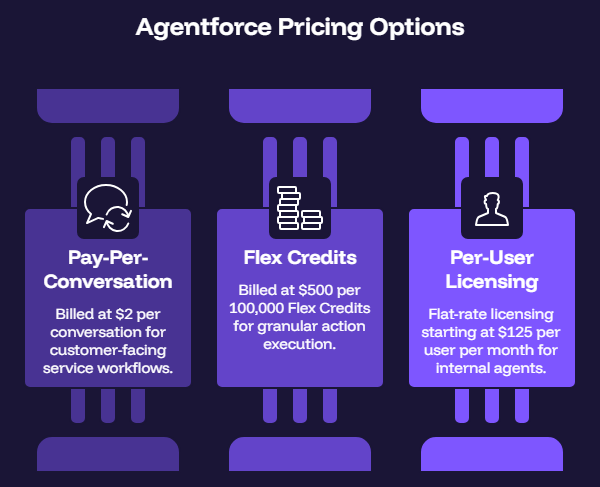
Salesforce offers three flexible pricing options for Agentforce deployments:
- Pay-Per-Conversation
Billed at $2 per conversation, ideal for customer-facing service workflows requiring multi-step resolutions within a single session.
- Flex Credits
Billed at $500 per 100,000 Flex Credits ($0.005 per credit), charging granularly per action executed.
- Per-User Licensing
Flat-rate digital labour licensing starting at $125 per user per month for employee-facing internal agents.
The total cost of ownership is driven by interaction volume, topic complexity, Data Cloud storage, and integration scope.
Implementation of Salesforce Agentforce
Implementation of Salesforce Agentforce typically follows five stages, and these stages are mentioned below.
- Defining the agent's scope and guardrails.
- Mapping the actions and data sources it needs.
- Building and testing topics in a sandbox.
- Running a controlled pilot with live escalation paths.
- Monitoring performance for continuous tuning after go-live.
This is exactly the phase where working with a certified Salesforce consulting partner becomes an effective step, because the sequencing and guardrail design require both Salesforce experience and architecture, and also a clear view of your existing service processes.
Why Should You Streamline Your Agentforce Rollout with ProvidusCRM?
Deploying Agentforce well is less about flipping a feature on, but, importantly, it is more about data readiness, disciplined scoping, and guardrail design, the same principles that separate a successful CRM project from a stalled one.
ProvidusCRM's certified consultants have implemented Salesforce's AI and automation capabilities across UK field operations, service, and sales, and we build agents that are grounded in real data from the first day. Talk to our team and get your problem sorted.
Conclusion
In short, the question of how Salesforce Agentforce works comes down to four repeatable steps, retrieve, interpret, act, and escalate within clear guardrails. Pairing a reasoning engine with your live CRM data and a defined set of approved actions.
This combination is what separates it from earlier scripted chatbots and briefly explains why independent analysts expect autonomous resolution rates to climb sharply over the next few years. Additionally, getting there safely still depends on clean data, careful scoping, and a rollout plan built by a team that understands both the platform and your service operation.
Frequently Asked Questions
1. How does Salesforce Agentforce work in simple terms?
It reads a customer request, checks your live Salesforce data, decides on the right action, and, importantly, either completes it automatically or hands it off to a human agent with full context.
2. What is Salesforce Agentforce built on?
It runs on Salesforce's Atlas Reasoning Engine, using actions, topics, and guardrails defined by your admin team, grounded in your existing CRM records.
3. Is Salesforce Agentforce different from a chatbot?
Yes. Chatbots follow fixed scripts, while Agentforce reasons over live data and can execute multi-step actions to actually resolve a case.
4. How much does Salesforce Agentforce cost?
Pricing is largely consumption-based, charged per completed conversation on top of your existing Sales Cloud or Service Cloud licences, rather than a flat per-seat fee.
5. How long does an Agentforce implementation take?
A focused pilot covering one or two topics can typically launch within a few weeks, though data readiness, scope, and integration complexity affect the timeline.