

Many advisers log into Salesforce Financial Services Cloud every single day, and they still use only a fraction of what sits inside it. The relationship maps, the dashboards, and even the compliance tools tucked one click away rarely get touched.
This gap matters more than it sounds. Kitces Research has found that the typical financial adviser spends only around 20% of their working time actually meeting clients, with the rest lost to preparation, searching for information, and admin. These eight features below are not buried in some obscure settings menu, but they sit in plain sight, and once you start using them for the practical work, it becomes hard to imagine working without them.
Underrated Salesforce Financial Services Cloud Features
Salesforce Financial Services Cloud is built specifically for the work of banks, insurers, and wealth managers, rather than acting as a generic CRM stretched to fit financial services. It basically combines compliance-ready documentation, AI- driven insights inside one platform, and household-level relationship data.
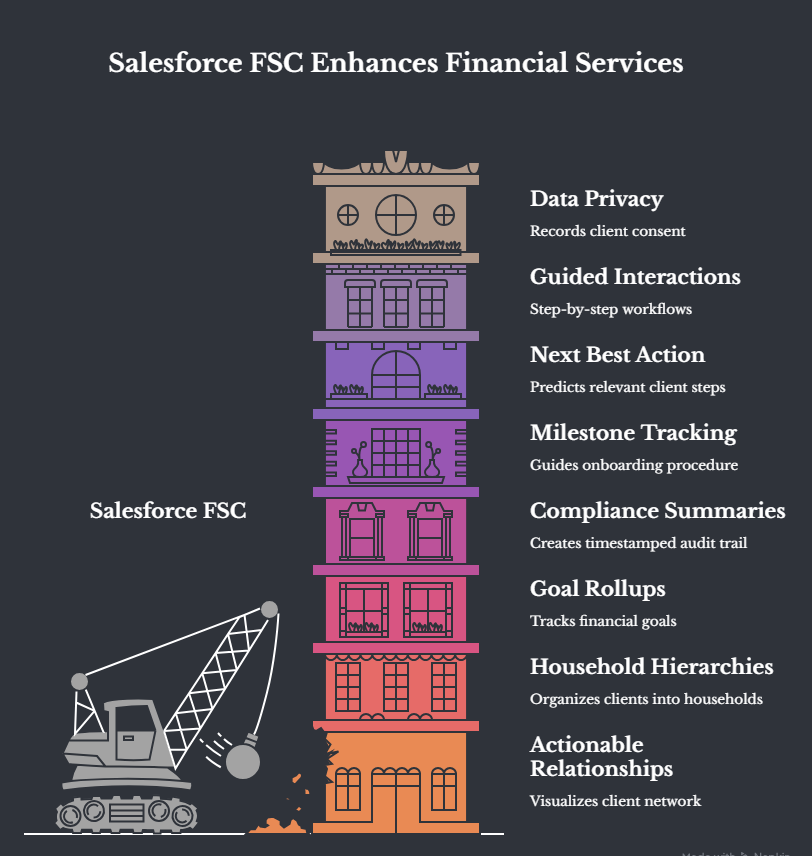
Furthermore, the capabilities of the platform go well beyond storing contact details. It now maps entire client households, automates paperwork-heavy workflows, and tracks financial goals that used to sit in spreadsheets. These Salesforce Financial Services Cloud features give advisers a more connected view of clients, relationships, compliance, and financial activity. Below are eight Salesforce FSC features many firms overlook entirely. Let’s understand them simultaneously.
1. The Actionable Relationship Center
The Actionable Relationship Center is one of the prominent features of Salesforce FSC client management. It actually visualises a client's entire network, trustees, business partners, family members, advisers, and business partners and presents it as an interactive relationship map. Instead of digging through notes, advisers can analyse who influences a client's decisions.
This single view mostly reveals referral opportunities and cross-selling that a standard contact list would never surface. Moving forward, new team members also ramp up faster with ARC, since the relationship history is visible immediately rather than buried across old handover notes and emails. This makes Salesforce FSC relationship management particularly useful for firms managing complex client networks.
2. Hierarchies of Relationship and Household Group
Salesforce FSC directly organises clients into households rather than making isolated individual records. This means an adviser who is managing a family across three generations sees shared goals, combined assets, and linked accounts in one screen. This Salesforce FSC household management capability gives advisers a clearer picture of how individual clients are connected.
This pattern of hierarchy is particularly important for estate conversations and succession planning, where understanding the process of how accounts connect across a family matters as much as the numbers themselves. Now, advisers no longer have to reconstruct these relationships on their own every time a new query comes in.
3. Household and Financial Goals Rollups
Interestingly, features of Salesforce FSC Wealth Management have the ability to track financial goals against real account performance and automatically roll up to the household level. Education funds, retirement targets, and investment milestones get updated as accounts change. These Financial Services Cloud capabilities help advisers maintain a more complete view of household financial progress.
Moreover, if you are exporting figures into a separate spreadsheet each quarter, advisers get a complete, live household-wide picture of progress. This eventually turns review meetings into genuinely useful conversations rather than only sessions of static reporting. Along with this, it also makes it far easier to highlight when a household is falling behind a goal early.
4. Summaries of Compliance-Ready Interaction
Every call log, email thread, and meeting note can be easily captured through structured Interaction Summaries, which are one of the most impactful and practical Salesforce FSC compliance tools.
These summaries actually create a consistent and timestamped audit trail without requiring advisers to write free-form notes. Additionally, firms in the UK financial services are now spending more than £33.9 billion a year on regulatory compliance, which is equal to over 13% of the operating costs. For this reason, compliance-focused Salesforce FSC features can play an important role in maintaining consistent records.
5. Guided Milestone Tracking for the Onboarding Procedure
KYC checks, client onboarding, and account transfers actually involve dozens of tiny steps that are very easy to miss under pressure. Action Plans and Path break these processes into visible, sequential steps and stages that update automatically as each requirement is met.
Interestingly, this is one of the most impactful Salesforce FSC compliance tools because it prevents any step of compliance from being skipped, and nothing moves forward unless the required stage is genuinely completed. These Salesforce Financial Services Cloud capabilities can help financial firms create more consistent onboarding processes.

6. Einstein-Powered Next Best Action (Platform Automation)
Utilizing core Salesforce platform automation within Salesforce FSC, Einstein's Next Best Action engine silently does some of the heaviest and most impactful actions. It scans life events, account activity, and market movement to predict the most relevant next step for every client. This demonstrates how Salesforce FSC automation can support more proactive client engagement.
An upcoming birthday, a maturing bond, or even a sudden change in risk tolerance can all eventually trigger a prompt. Furthermore, advisers stop completely relying on memory or start manual reviews to catch moments that matter most to the client relationship.
7. OmniStudio Guided Interactions
OmniStudio brings step-by-step guided workflows directly into the adviser's screen, which is one of the more overlooked Salesforce FSC tools for financial advisers. Risk assessment, account opening, and product applications can all be built as easy guided scripts versus scattered forms. This actually reduces training time for newer advisers considerably, since the system itself prompts the correct next question.
Consistency improves too, because every adviser directly follows the same structured path regardless of experience level. For multiple firms that are managing regulatory disclosures across multiple products, this consistency alone can reduce the risk of a step being missed. It also demonstrates how Salesforce Financial Services Cloud for wealth management can standardise important adviser workflows.
8. Data Privacy Management and Consent
Among the more advanced features, Salesforce leverages core Data Privacy and Consent Management objects (such as Individual and ContactPointConsent), which directly records exactly what a client has agreed to share, with whom, and when. This also matters under FCA and UK GDPR data-handling expectations. These Salesforce FSC data privacy and consent management capabilities give financial firms greater visibility into how client information and permissions are handled.
Privacy and Personalisation increasingly sit in tension with one another. Research cited by CFA Institute shows that 71% of consumers now expect personalised service, while 76% report frustration when firms fail to deliver it, which makes transparent consent tracking a genuine differentiator.
What Are The Tips For Salesforce Financial Services Cloud Adoption?
As you know, these features exist, but that's only half the challenge, and getting advisers to actually use them consistently is where most firms lose momentum. There are a few practical tips for Salesforce Financial Services Cloud adoption that make a big difference.
You can start by activating one or two features at a specific time rather than switching everything on at once, because advisers adopt new habits faster but in smaller steps. You can pair every new feature with a short and role-specific training session as compared to a generic system-wide announcement.
Interestingly, advisers are far more likely to use a tool, but only when they see it solve a problem specific to their own client book. You should review usage data monthly during the first quarter after rollout. If a feature such as Action Plans or ARC sits unused, this is the signal to revisit training rather than just assuming the feature itself has failed.
What Are the Best Practices for Salesforce Financial Services Cloud?
The best practices for Salesforce FSC implementations are obviously to share a common thread. For instance, they treat configuration as an ongoing discipline and not a one-off project. Permission sets, data models, and automation rules require regular review as a firm's client base grows.
Moving further, involve compliance and front-office teams from the very first design stages, not after go-live. Features like consent tracking and Interaction Summaries only deliver their full value when they are built around how compliance actually reviews records, rather than retrofitted afterwards.
You should revisit the data model annually as regulatory requirements evolve. For instance, a configuration that has satisfied FCA expectations two years ago may now need adjustment given how quickly reporting standards shift.
Why Should You Streamline Your Financial Services Cloud Setup With ProvidusCRM?
Unlocking the full potential of Salesforce Financial Services Cloud rarely happens by accident, but it always takes a certified team that understands both the regulatory reality UK financial services firms operate under and the architecture of the platform.
ProvidusCRM's certified Salesforce consultants help wealth advisers, managers, and financial institutions configure Financial Services Cloud around how their teams actually work, and especially not a generic template. Explore our Salesforce Consulting Services to talk through your current setup and, importantly, the features you may still be missing.
Conclusion
Salesforce Financial Services Cloud is capable of far more helpful features. From relationship mapping and household rollups to consent tracking and compliance-ready summaries, these eight features mentioned above quietly solve problems that cost advisers real time every week.
Importantly, these features can support more consistent recordkeeping and onboarding when properly configured, adopted, and maintained. This shift alone can be the huge difference between a CRM that gets tolerated and the one that genuinely earns its place.
Frequently Asked Questions
1. What is Salesforce Financial Services Cloud used for?
Salesforce Financial Services Cloud is a CRM platform that is built specifically for wealth managers, banks, and insurers, and it also combines compliance documentation, household relationship data, and AI-driven insights in one system.
2. Is Salesforce Financial Services Cloud only for large firms?
No, while it is widely used by enterprise wealth managers, its modular structure means smaller advisery firms can also activate only the features they need and scale up over time.
3. What are the capabilities of Salesforce Financial Services Cloud for compliance?
It offers structured Interaction summaries, data-sharing tracking and consent, and also the milestone-based onboarding workflows that create a consistent but timestamped audit trail for regulators.
4. How do the features of Salesforce FSC wealth management help advisers?
Financial goal tracking and household rollups give advisers a live, family-wide view of progress and assets, and it replaces manual spreadsheet reporting with continuously updated data.