

Every sales leader has once thought, why do some teams hit their revenue targets quarter after quarter, while the others fall short despite working hard?
The answer hardly hides behind the efforts, but it comes down to the platform behind that effort, and this is exactly the point where the 10 benefits of Salesforce Sales Cloud start to matter. The right CRM always converts scattered activity into a repeatable and measurable process. Let’s understand it in steps.
What Is Salesforce Sales Cloud and Why Does It Impact Revenue?
Salesforce Sales Cloud is a cloud-based CRM that is built specifically for sales teams, and it also centralises leads, contacts, accounts, and opportunities all in one platform, so that the reps and the managers work from a single and shared version of the truth.
The revenue growth of Salesforce Sales Cloud is accelerated by removing the guesswork that slows deals down. When every touchpoint, note, and next step lives in one system, the result is that sales cycles get shorter and conversion rates improve.
Why Does Revenue Growth Depend on a Thoughtful CRM?
Independent research shows us that the CRM adoption pays for itself multiple times. Nucleus Research, an independent technology research firm, has discovered that a well-run CRM deployment pays back $8.71 for every dollar spent.
Moving further, the market analysis of Gartner has reported that the CRM sales software market grew 12.2% to $25.7 billion in 2024. This rise in it is directly connected to the strong ROI that has been generated by improving seller efficiency with AI-powered tools. These are the specific statistics that tell us and also help us to understand why the benefits of Salesforce Sales Cloud that are mentioned below require serious attention.
10 Benefits of Salesforce Sales Cloud That Drive Revenue Growth
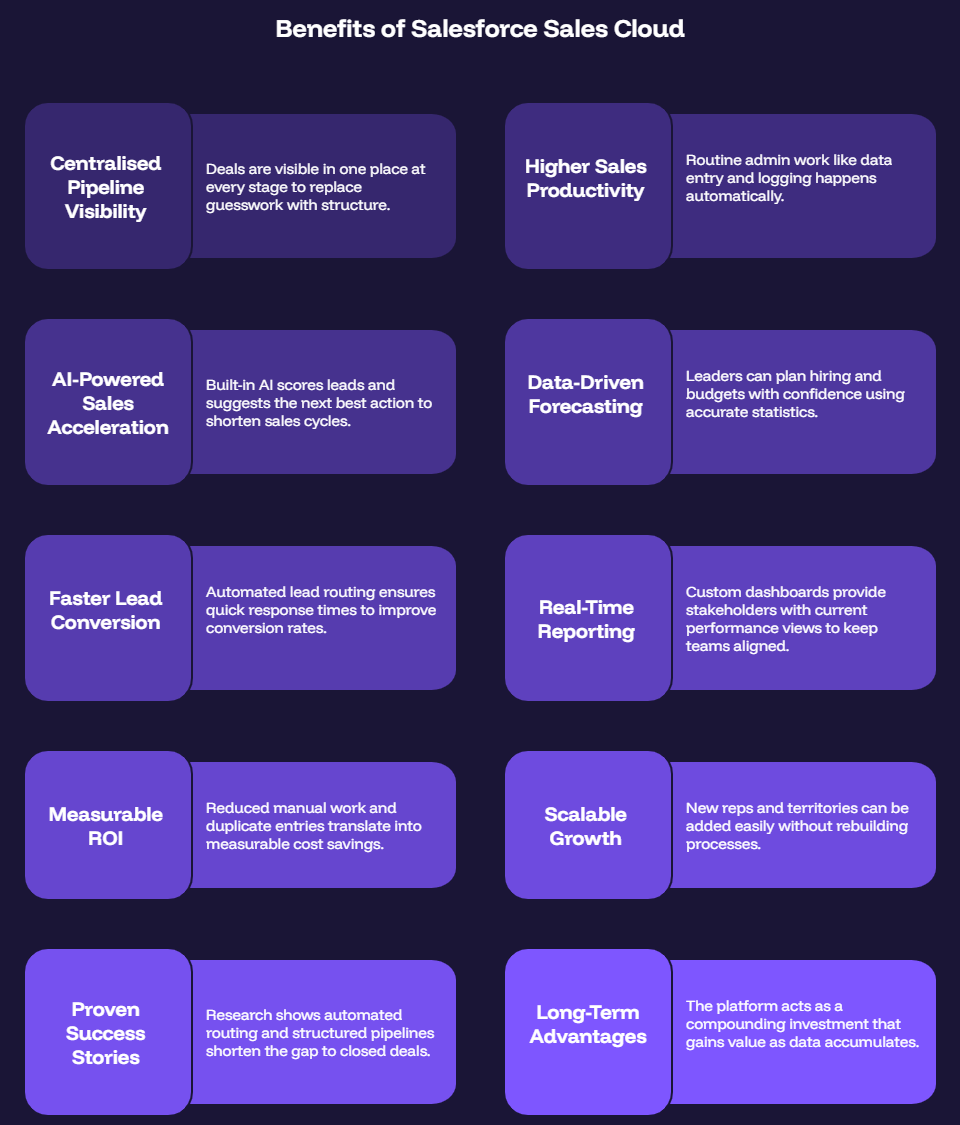
1. Visibility of Centralised Pipeline
One of the biggest and most impactful benefits of Salesforce Sales Cloud pipeline management is that each deal becomes visible in one place and at every stage. Managers can easily spot stalled opportunities before they silently disappear from the forecast.
This visibility helps to replace guesswork with structure. Sales representatives know exactly what they have to do next on every specific account, and leadership always knows where the revenue genuinely stands. Moreover, custom stage rules also stop deals from advancing before the key steps are completed.
2. Higher Productivity in Sales Through Automation
Salesforce Sales Cloud sales productivity improves simultaneously because routine admin work, for instance, data entry, follow-up reminders, and activity logging, happens automatically. Reps start to spend far less time updating records and more time mainly selling.
Automated task assignment and email templates also remove repetitive manual steps from the sales process.
3. AI-Powered Sales Acceleration
Salesforce Sales Cloud sales acceleration comes from built-in AI that eventually helps score leads, flag at-risk deals, and suggest the next best action. Reps prioritise the opportunities that are most towards closer rather than chasing every lead.
This process of acceleration shortens the average sales cycle. Deals move through the pipeline faster because the attention is directly directed where it has the greatest impact.
4. Data-Driven and Accurate Forecasting
Leaders who trust their statistics can plan hiring, budgets, and territory coverage with genuine confidence instead of being caught by last-minute surprises.
This follow-up work and accuracy also protect revenue targets from being missed and continuously guide teams to take the best possible action.
5. Faster Lead-to-Opportunity Conversion
Automated lead routing sends new leads to the right rep based on deal size, territory, and product line, and nothing sits unassigned in a queue for days.
Moving further, quick response times directly improve conversion rates. Buyers engage with the seller who reaches them first with the most timely and relevant information.
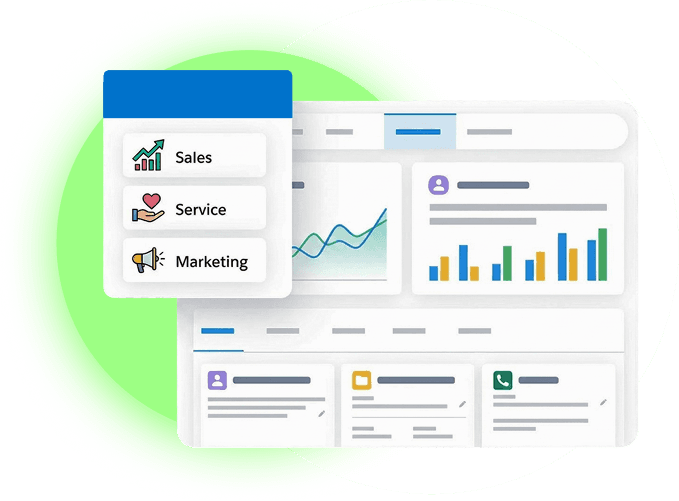
6. Real-Time Reporting Helps to Keep Everyone Aligned
Custom dashboards give each stakeholder the exact view of the performance they usually look for, starting from reps to executives. No one has to wait for a weekly spreadsheet update in order to track the quarter.
This alignment eventually reduces the friction between sales, marketing, and finance. Decisions get aligned and are also made on current data rather than assumptions from the last month.
7. Measurable Salesforce Sales Cloud ROI With Reduced Manual Work
Salesforce Sales Cloud ROI becomes solid, but only once manual processes are removed from the sales day. Fewer duplicate data entries, missed follow-ups, and spreadsheets all get translated into hard cost savings.
These savings sit alongside the revenue gains from faster cycles and better conversion, and together they form a return that ultimately finance teams can actually measure and also defend.
8. Scalable Growth Across Territories and Teams
The impact of Salesforce Sales Cloud on business growth becomes visible as a company scales. New reps, territories, or business units can be added easily without even rebuilding the sales process from scratch.
Configurable permissions, roles, and territory rules mean the platform will grow alongside the business, and the main point is that growth stops being limited by internal process gaps.
9. Proven Success Stories of Salesforce Sales Cloud
Real-world evidence also gives authenticity. Research published in the Harvard Business Review shares that firms contacting a lead within an hour were seven times more towards to qualify as compared to those that waited even a little longer.
These also reflect a consistent pattern across automated routing, sales organisations, and structured pipelines that reliably shorten the gap between a new lead and a closed deal.
10. Long-Term Advantages of Salesforce Sales Cloud for Sustainable Growth
The advantages of Salesforce Sales Cloud extend well beyond the first year of its use. As data accumulates, automation deepens, forecasting sharpens, and reps build habits around a single and reliable system of record.
Salesforce Sales Cloud for revenue growth is eventually a compounding investment. The platform gets more valuable as a team starts to use it properly, rather than just losing effectiveness over time.
How Can Salesforce Help Us Hit Revenue Targets Faster?
Hitting a revenue target quickly is less about working longer hours and more about accurate forecast categories, configuration, clean pipeline stages, automated lead routing, and dashboards that flag the risk element early.
Moreover, a well-configured sales cloud org gives managers more clarity to intervene on a slipping deal in week two, not in week eleven; this is mostly the difference between a missed quarter and a met one.
Teams that pair this configuration with consistent CRM adoption and disciplined pipeline reviews tend to see quick results. The technology creates the opportunity, and consistency in usage is what converts it into revenue.
So, if your organisation also wants to turn Sales Cloud into an impactful revenue engine rather than an expensive contact database. ProvidusCRM’s Salesforce Sales Cloud consulting team can help you out in configuring the platform around your actual sales process.
Get in coordination and talk through your current pipeline, targets, and timeline with a certified Salesforce team.
Conclusion
The benefits that are discussed here lead to one thing, and that is revenue growth is hardly a mystery once the right platform and processes are in place. Visibility, automation, accurate forecasting, and AI-driven prioritisation, each of these helps to remove a specific point of friction from the process of sales, which ultimately enhances the process.
None of these benefits become visible automatically by purchasing a licence, but they depend on genuine team adoption, thoughtful configuration, and clean data, which is the point where an experienced implementation partner earns its value.
Frequently Asked Questions
1. How does Salesforce Sales Cloud increase revenue?
It increases revenue by shortening sales cycles, improving forecast accuracy, routing leads faster, and giving managers early visibility into deals at risk of stalling.
2. What kind of ROI can businesses expect from Salesforce Sales Cloud?
Returns vary by adoption and configuration, though independent CRM research from Nucleus Research points to an average payback of $8.71 for every dollar spent on a well-run deployment.
3. Is Salesforce Sales Cloud suitable for small and mid-sized businesses?
Yes. Sales Cloud is configurable by team size, so smaller businesses can easily start with core pipeline and automation features and scale up as headcount and territory complexity grow.
4. How long does it take to see results from Salesforce Sales Cloud?
Multiple teams see early gains in productivity within the first few months, while the full Salesforce Sales Cloud ROI typically builds over a longer period as the adoption matures and data accumulates.
5. Do we need a consultant to implement Salesforce Sales Cloud properly?
It is not mandatory, but yes, a certified implementation partner definitely reduces the risk of missed automation opportunities, poor configuration, and low adoption that limit long-term revenue impact.
6. How is Sales Cloud different from other Salesforce products?
Sales Cloud is built specifically for revenue processes, but products such as Service Cloud and Marketing Cloud focus on customer support and marketing automation.